Material identity
Ganoderma fungal materials: verify species (including G. lingzhi versus G. lucidum), fruiting body, mycelium or spores and cultivation substrate. Reishi is a fungus, not a plant.
Reishi is a commercial name, not a complete ingredient specification. A primary comparison distinguished European Ganoderma lucidum and East Asian G. lingzhi by morphology, molecular phylogeny and triterpenic-acid profiles; this article retains each study’s reported species name rather than reidentifying its sample.[15]
For development, specify species, fruiting body or mycelium or spores, cultivation substrate, extraction solvent, retained fraction and carrier. The practical choice is whether the product needs a dispersible fungal powder, a water-extractable polysaccharide fraction or an alcohol-extracted triterpenoid fraction; a high extraction ratio does not answer that question. The extraction experiment below measured these fractions separately.[28]
Effects and human research
An eight-week randomized, double-blind trial tested Ganopoly, containing 25% crude polysaccharides, at 1,800 mg three times daily in patients diagnosed with neurasthenia. The trial randomized 132 patients and reported improvement analyses for 62 Ganopoly recipients and 61 placebo recipients. Fatigue scores fell 28.3% and 20.1% from baseline, respectively. Although the paper reported lower day-56 fatigue scores with Ganopoly, its drug-by-time interaction for fatigue was not significant (P=0.1590). The interaction was significant for well-being (P=0.0002). These mixed analyses warrant caution when interpreting symptom benefit.[7]
This is a signal for that preparation and diagnosed population, not proof that a low-dose reishi drink treats insomnia, ordinary tiredness or modern ME/CFS. The short course, subjective scales and substantial placebo improvement limit transfer to a finished food. The studied daily amount was 5.4 g of extract, not 5.4 g of whole mushroom and not a recommended consumer dose.[7]
In contrast, a 16-week randomized trial enrolled 84 people with type 2 diabetes and metabolic syndrome. Participants received 3 g/day Ganoderma, with or without Cordyceps, or placebo. Recruitment fell short of the planned 168, and the two active arms were pooled; the combined intervention did not significantly improve HbA1c, fasting plasma glucose or secondary cardiovascular-risk outcomes. This does not support a glucose-lowering claim or prove a Ganoderma–Cordyceps synergy.[20]
Polysaccharide and triterpenoid research includes laboratory antioxidant assays and animal experiments. DPPH scavenging in an extract is not a human immune endpoint; the patent case below used high-fat-fed mice, not a completed human weight-loss trial. A patent’s treatment claim must not become food-label efficacy evidence.[28][34]
Material forms and composition
Water-extractable polysaccharides and alcohol-oriented triterpenoid fractions differ; total sugars are not beta-glucan identity.
| Form | Use in development | What to qualify |
|---|---|---|
| Fruiting-body powder | Suspended powders or textured foods; not assumed to dissolve | Species voucher, particle size, grit, insoluble fraction and microbial load. |
| Water extract / polysaccharide-enriched powder | Instant powders or capsules after reconstitution testing | Actual β/α-glucan methods, drying carrier, insolubles and dry-basis composition.[23][28] |
| Ethanol extract / triterpenoid fraction | Capsules or a separately developed dispersion | Chromatographic fingerprint, bitterness, precipitation and residual ethanol; colourimetric equivalents are not named ganoderic acids.[28] |
| Dual extract | Blend only after setting the relative fraction amounts | Declare sequential extraction, co-extraction or separate extraction/blending; assay retained streams.[28] |
| Mycelium and mycelial fractions | A separate raw-material and fermentation specification | Disclose culture/substrate and isolate identity. The US patent concerns mycelial polysaccharides, not arbitrary fruiting-body powder.[34] |
| Spore powder / spore oil | Separate qualification and regulatory review | A spore preparation is not supported by fruiting-body extraction results; spore powder may interfere with CA72-4 testing.[33] |
Application selection
Polysaccharide-oriented beverages and triterpenoid-oriented concentrates require different development paths. For ambient-water instant powders, measure wetting, reconstituted insolubles and vertical marker distribution at the actual dose. For clear beverages, define acceptable target-fraction losses: removing particles or aggregates does not automatically preserve extract composition. Triterpenoid fractions should be screened for bitterness, precipitation and carrier needs. Their profiles can differ between Ganoderma materials, so sensory and dispersion experience with one material is not a genus-wide property.[15]
R&D should blind-test water extract, triterpenoid-related fraction and a measured blend separately at equal target-component dose, with an extract-free formulation blank. Engineering should measure solids and beta-glucan/triterpenoid-related attributes before and after filtration so improved clarity is associated with a quantified loss. Procurement should disclose starch-containing carriers and their effects on alpha-glucan interpretation rather than calculating target components from total powder mass. Brand language should focus on verified provenance, fraction, flavour and dispersion; an evening-drink concept does not itself establish a sleep benefit.
Capsules shift the brief toward target-component loading per unit volume, flow and within-batch uniformity. Concentrated liquids require attention to physical changes after thermal processing and opening. Proposed tests should use actual packaging and pair whole-container redispersed samples with supernatant samples. Record viscosity increase, precipitation and darkening separately rather than hiding distinct mechanisms behind one “stability passed” statement. Application acceptance windows should follow the product brief, not an in-vitro antioxidant concentration converted into a food dose.
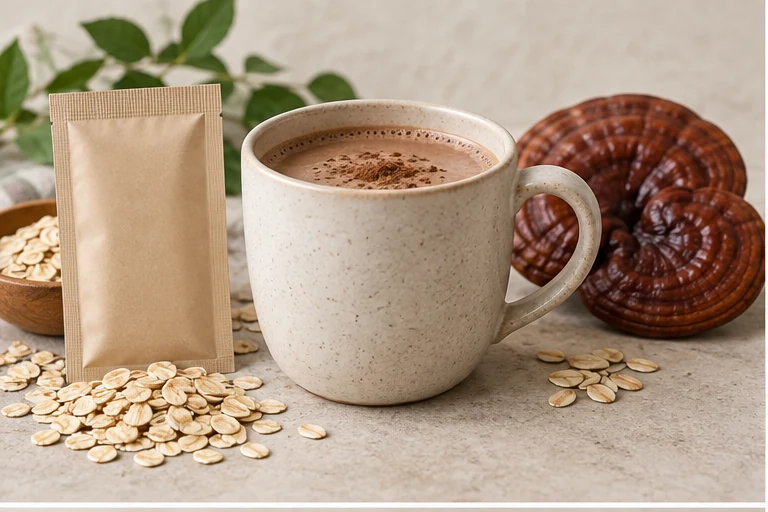
- Cocoa–oat reishi drink powder · Use a water-extract powder as the defined reishi component, cocoa for the main flavour, oat beverage powder for body, an appropriate sweetener for bitterness balance, and sunflower lecithin as a wetting aid to screen
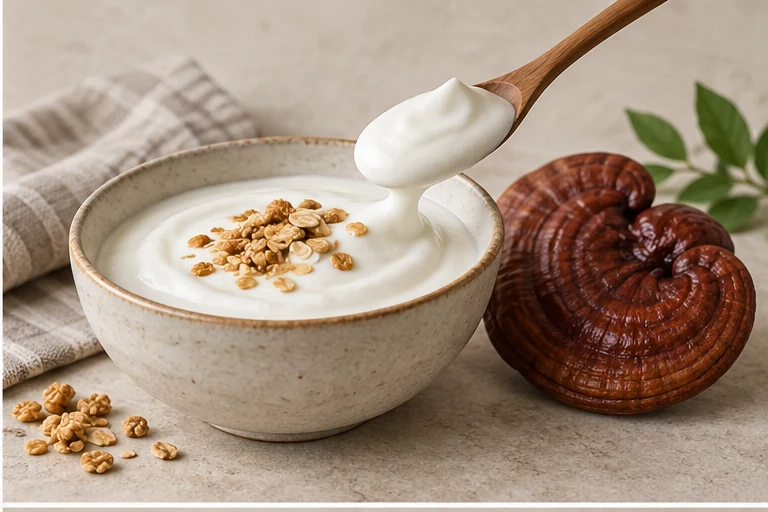
- Reishi cultured yogurt · Pair a qualified water extract with milk, conventional yogurt starter and a documented probiotic strain selected for the intended product
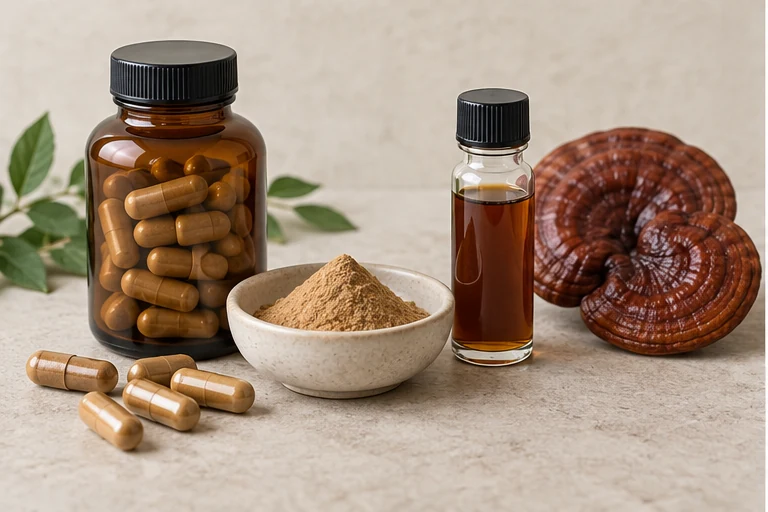
- Defined reishi extract capsule · Combine a standardized water-extract fraction with microcrystalline cellulose for fill-volume adjustment, an allowed silica grade as a flow-aid candidate, and an HPMC capsule shell
End-product selection
Capsules, tablets, mushroom drink powders and suspension concepts.
Powder, oral-solid and beverage formulation development with fraction-specific testing.
Three product development plans
These are pilot-development proposals. Ingredient roles, addition order and acceptance tests must be qualified in the final product.
Cocoa–oat reishi drink powder
Use a water-extract powder as the defined reishi component, cocoa for the main flavour, oat beverage powder for body, an appropriate sweetener for bitterness balance, and sunflower lecithin as a wetting aid to screen. These are formulation roles, not evidence of physiological synergy. Declare the oat and extract carriers; otherwise matrix carbohydrate can obscure the mushroom glucan result. Mushroom β-glucan analysis needs a defined total/α-glucan method.[23]
Proposed order: sieve each powder, geometrically premix the reishi extract with part of the oat base, add cocoa and the remaining base, then add the selected dry lecithin system and sweetener using a validated blend sequence. Compare simple blending with controlled agglomeration only if wetting remains poor. Fill moisture-barrier sachets; assess the actual water temperature and serving dilution rather than a dilute laboratory solution.
Proposed quality gates: record wetting time, dry-core lumps, sediment after a defined hold, bitterness and powder caking. Take top/middle/bottom blend samples and compare whole-cup redispersed samples with the supernatant. Test matrix blanks and recovery before assigning all measured β-glucan to reishi; oat and fungal carbohydrates are not analytically interchangeable. A cocoa drink is not a sleep treatment, and insomnia is among the reported adverse effects of reishi supplements.[23][33]
Reishi cultured yogurt
Pair a qualified water extract with milk, conventional yogurt starter and a documented probiotic strain selected for the intended product. Milk proteins supply the gel structure; the starter acidifies; reishi supplies the characterized fungal fraction. Optional vanilla and a permitted sweetener address flavour rather than immune claims. The published application compared powder and extract with L. acidophilus and B. animalis subsp. lactis, but increased counts in a food matrix do not demonstrate a human prebiotic benefit.[31]
Proposed order: disperse extract in a milk side-stream, combine with the standardized milk base, and compare addition before the validated heat treatment with a separately decontaminated aseptic addition route if heating damages performance. Cool to the starter supplier’s inoculation condition, add cultures, ferment to a defined endpoint, cool promptly, then package under hygienic control. Do not add untreated botanical powder after the kill step merely to follow a laboratory recipe. The cited study heated milk at 85°C for five minutes, cooled to 45°C and added reishi before fermentation; this is a study condition, not a universal factory schedule.[31]
Proposed quality gates: follow the acidification curve, strain-specific viable counts through the intended refrigerated shelf life, syneresis, viscosity, grit and flavour. Include milk-only and culture-only controls and compare extract versus powder on an explicitly declared solids basis. Do not inherit the paper’s dose: its methods say 0.1%/0.2% while Table 1 labels 1%/2%; resolve the discrepancy with the authors before replication. The 20 trained panelists were not a population-scale consumer trial.[31]
Defined reishi extract capsule
Combine a standardized water-extract fraction with microcrystalline cellulose for fill-volume adjustment, an allowed silica grade as a flow-aid candidate, and an HPMC capsule shell. A triterpenoid fraction can be a separately assayed optional component, not an automatic upgrade. This proposal pairs the ingredient with dosage-form excipients rather than adding another herb whose contribution cannot be separated. Set extract mass and marker mass per capsule independently; the neurasthenia study’s preparation and exposure are not established by matching the word reishi.[7]
Proposed order: condition the powder under a documented moisture window, sieve, premix extract and part of the filler, then add the remaining filler. Add flow aid near the end and establish mixing time experimentally. If a lubricant is needed, qualify it separately rather than assuming more is better. Confirm bulk/tapped density and flow on the intended encapsulator before fixing shell size; fill, inspect, and seal in a moisture-controlled package.
Proposed quality gates: measure individual fill weights, blend/finished-unit marker uniformity, disintegration, microbial limits and moisture change in the real package. Assay glucans in a validated matrix method and triterpenoid markers separately where declared. Reject an untraceable extract even if capsule weight passes. The label review must address bleeding risk with anticoagulants and immunosuppressant use; a capsule’s accurate fill does not make it safe for these groups.[12][33]
Processing and equipment
A polysaccharide-oriented powder and a triterpenoid-oriented fraction need different solvent selectivity. Sequential or parallel extraction and blending must identify retained streams; a dual-extraction label does not mean maximal recovery of everything.[9] [12]
Begin by identifying the fungal material, not by selecting an extraction ratio. Commercial Ganoderma names have been used inconsistently. A study combining morphology, molecular phylogeny and triterpenic-acid profiling distinguished European G. lucidum from East Asian G. lingzhi, demonstrating why appearance and a traditional trade name cannot replace identity and chemical comparison.[15] This report preserves the name G. lucidum used by the 2020 extraction paper rather than retrospectively reidentifying its sample. Procurement should connect species and identification basis with fruiting body/mycelium/spores, cultivation inputs and harvest batch; R&D should retain a voucher. Powder colour or total sugar cannot reconstruct those starting-material facts.
Water-extractable polysaccharides and alcohol-extractable triterpenoids require different selectivity. Increasing ethanol can favour some relatively less-polar constituents while lowering the solubility and recovery of some polysaccharides. The 2020 aqueous-ethanol ultrasound study illustrates this trade-off: it selected joint conditions with a desirability function assigning a 0.5 weight to each yield, rather than establishing the maximum recovery of each fraction independently.[28] “Dual extraction” should specify sequential extraction, parallel extraction followed by blending, or co-extraction in one aqueous-alcohol system; their retained streams and profiles are different.
The study used dried material purchased from a local pharmacy in Fujian, China, ground to 40 mesh. For the hot-water control, powder was first treated with 80% ethanol to remove some coloured compounds, small sugars and other small molecules, then dried at 40°C. One gram of treated powder was extracted with 40 mL deionized water in a 150 mL flask at 95°C for two hours, repeated once, and centrifuged at 8000×g for ten minutes. The alcohol control instead used 1 g powder with 40 mL 95% ethanol at 30°C with gentle shaking for six hours, repeated once.[28] The pretreatment difference matters: comparing only temperature and duration overlooks that the analytical starting bases may already differ.
Co-extraction used 1 g powder in a 150 mL flask placed in a 40 kHz ultrasonic cleaning bath with a usable capacity of 3 L. The validated conditions were 50% v/v ethanol, 50 mL/g liquid-to-solid ratio, 80°C, 100 minutes and a device power of 210 W. Measured polysaccharide and triterpenoid yields were 0.63% and 0.38%; the two-extraction conventional controls yielded 1.52% polysaccharides and 0.59% triterpenoids, respectively.[28] Co-extraction offered process integration but did not exceed the separate conventional yields in these data. “Ultrasound-assisted” must not be translated into a guaranteed higher yield, and a bath power setting cannot be scaled linearly by kilograms of feed.
Separation requires explicit stream ownership. The authors added 95% ethanol to co-extract supernatant to reach a final ethanol concentration of 75%, held it at 4°C for twelve hours and separated the polysaccharide precipitate by centrifugation. The supernatant was used for triterpenoid measurement; the precipitate was washed twice with 95% ethanol and redissolved in water for polysaccharide analysis.[28] Thus, the precipitate was not the whole extract, and the principal analytical triterpenoid stream was another liquid. A proposed process-development balance should number and measure precipitate, washings, supernatant and insoluble residue. If only precipitate is retained in a “triterpenoid-rich dual extract,” data must show where its triterpenoids remained.
Wet polysaccharide cake then requires desolventization, drying and reconstitution testing. The other supernatant needs solvent recovery, concentration and possibly carrier formulation. Membrane concentration is a potential alternative or supplement for a polysaccharide project, but nominal molecular-weight cutoff does not directly determine the molecular-mass distribution of recovered polysaccharides: aggregation, shape and fouling can affect transmission. Select a membrane through retentate/permeate sugar composition, glucan assay, molecular-weight distribution and mass balance. This is a proposed engineering development route, not membrane scale-up already demonstrated by the 1 g experiment.
The following is a proposed equipment framework derived from the verified extraction and fractionation principles, for pilot development.[28]
| Objective/equipment | Reason for use | Trade-off | Acceptance evidence |
|---|---|---|---|
| Jacketed hot-water extractor | Establishes temperature, time and mixing windows for water-extractable fractions | Relatively direct route; thermal history and concentration duty need evaluation | Extraction curve, residue glucans/sugars, viscosity, dry-basis recovery |
| Closed alcohol extractor and condenser | Recovers triterpenoid-related constituents and contains vapour | Combustible-solvent handling and recovery compared with a water line | Actual ethanol strength, losses, fingerprint, residues, safety design basis |
| Ultrasound bath or flow cell | Tests co-extraction or shorter processing | Field distribution, heating and abrasion may limit scale-up | Energy per processed volume, thermal history, energy at matched recovery |
| Controlled precipitation vessel and separator | Transfers part of the polysaccharides into recoverable solids | Cooling, ethanol demand, mixing and volume turnover | Final ethanol strength, uniform addition, separation, wash losses |
| Filter versus centrifuge | Cake washing versus handling certain difficult suspensions | Fouling, adsorption and shear require actual comparison | Flux/pressure curve, postseparation recovery, cleaning validation |
| Ultrafiltration/diafiltration pilot | Explores concentration and removal of smaller molecules | Different water demand, fouling and selectivity versus solvent fractionation | Both-stream profiles, flux restoration, molecular-weight change |
| Vacuum concentration and spray/freeze drying | Produces a controlled-moisture powder | Wall deposition and carriers versus cycle length and reconstitution | Solids recovery, moisture/water activity, carrier and insoluble fraction |
Vessel volume alone is inadequate. Extraction requires mixing and heat transfer in the actual viscous liquor; precipitation needs ethanol addition that avoids locally concentrated, difficult-to-wash clumps; separators need a balance of supernatant retained in wet cake and associated marker losses. Recycled ethanol strength becomes a process input because water/alcohol composition changes selectivity.[28] Define equipment acceptance through target-fraction recovery, cleaning and solvent closure, not simply successful mechanical operation.
Quality and safety
The co-extraction paper measured polysaccharides by the phenol–sulfuric acid method against D-glucose and triterpenoids by the vanillin–glacial acetic acid method against ursolic acid, expressing the latter as ursolic-acid equivalents.[28] Accordingly, 0.63% is not a beta-glucan recovery and 0.38% is not an HPLC-confirmed sum of ganoderic acids. A contract comparing colour-reaction equivalents directly with named chromatographic analytes can create an apparent price difference driven by assay choice rather than material quality.
McCleary and Draga's mushroom/mycelial-product method uses controlled sulfuric-acid hydrolysis and glucose-specific detection for the total-glucan-related measurement, a separate enzymatic channel for alpha-glucan and relevant free-sugar contributions, and calculates beta-glucan by difference. Their abstract reports higher values with sulfuric acid than the compared hydrochloric-acid procedure for certain samples including G. lucidum and Poria, and generally lower results from fully enzymatic hydrolysis.[23] A COA therefore needs more than “beta-glucan method”: fix the version, preparation, acid-hydrolysis conditions, alpha-channel treatment and dry/as-is basis. Resolve laboratory disagreements through retained samples, common methods, parallel digestion and suitable spikes/reference samples rather than choosing the higher result.
Alpha-glucan alone does not establish adulteration with starch; beta-glucan by difference does not establish species, fruiting-body provenance or absence of substrate. Identity and supply-chain evidence answer a different question from compositional quantification.[23][15] A proposed QA hierarchy includes species and part, matrix disclosure, beta/alpha-glucans and any necessary total-sugar measurement, triterpenoid fingerprint and agreed individual markers, moisture, microbiology, relevant contaminants and used solvents. Dedicated triterpenoid specifications need suitable reference standards and chromatographic confirmation, not a subjective bitterness threshold.
For US dietary-supplement manufacture, 21 CFR 111.70 requires component identity and necessary purity, strength, composition and contaminant limits, as well as appropriate process and finished-product specifications.[12] That is a legal basis for a control system, not a universal beta-glucan or triterpenoid percentage for reishi. Foods, supplements, medicines, spore oils and new fractions cannot be treated identically because they share a reishi name. Naming the exact material and destination in a contract is more actionable than an undefined “pharmacopoeial grade.”
MSK lists nausea, insomnia and liver injury among reported adverse effects, and warns about increased bleeding risk with anticoagulants/antiplatelets and possible conflict with immunosuppressants. Its CYP interaction information is from in-vitro work with uncertain clinical relevance; do not present it as a quantified human interaction.[33]
Spore powder warrants a specific conversation with the oncology team because elevated CA72-4 after supplementation can complicate interpretation of monitoring. This is not evidence that spores cause cancer or that a rising marker should be ignored. MSK also describes liver-injury case reports; these do not establish the incidence for a standardized extract.[33]
The metabolic-syndrome trial excluded pregnancy/breastfeeding, known mushroom allergy, anticoagulant use, abnormal hemorrhaging and serious illness including hepatitis. Its tolerability findings cannot establish safety in those excluded groups or in children. Consumers taking anticoagulants, immunosuppressants or cancer therapy need clinician/pharmacist review before supplementation; new jaundice, dark urine or unusual bleeding calls for stopping the supplement and prompt medical assessment.[20][33]
Buy this ingredient: specifications, COA, certification documents & pricing →
Practical questions
| Question | Actionable answer |
|---|---|
| Does 30% polysaccharides mean 30% β-glucan? | No. Require the specified glucan method, α channel and dry/as-is basis; colourimetric total sugar is a different measurand.[23][28] |
| Is a darker, more bitter lot stronger? | Not an assay. Compare an authenticated fingerprint and agreed markers; species/material differences can change triterpenic-acid profiles.[15] |
| Can we discard the ethanol-precipitation supernatant? | Only after a stream balance. The extraction study used supernatant for triterpenoid analysis and the precipitate for polysaccharides.[28] |
| Does high α-glucan prove adulteration? | No. Separate identity, substrate/carrier disclosure and compositional testing; the method measures starch/glycogen-related α-glucan, not supplier intent.[23] |
| What should a cloudy drink investigation measure? | Proposed diagnostic: compare whole-container, supernatant and sediment marker mass, then test pH/heat/water-hardness changes separately. Do not claim stability from a clear fresh filtrate. |
| Can the yogurt paper supply a manufacturing dose? | Not without clarification: methods give 0.1%/0.2%, Table 1 gives 1%/2%. Maintain both readings in the evidence record.[31] |
Research cases
Revisit the joint optimization objective first. The 2020 study gave the two fractions equal weights and obtained lower joint yields than the respective conventional controls. A beta-glucan-led product may need a different objective.[28] Define target-component mass, accompanying composition, solvents and cost, then compare water extraction, alcohol extraction, sequential extraction and blending. Engineering should document stream volumes and recovery energy; procurement should compare cost per accepted target component rather than powder yield. Add a glucan-specific method so a total-sugar response does not optimize unwanted small sugars.
A second programme should investigate molecular-weight distribution and structural preservation. Breaking a macromolecule can leave a similar total-sugar colour response while changing viscosity and reconstitution; measure the distribution and appropriate structural attributes rather than assuming stronger ultrasound is better. The paper's DPPH and reducing-power tests are in-vitro chemical measurements, not predictions of food-mediated immune outcomes.[28] Future cell studies should characterize purity, proteins/coextractives and endotoxin controls so a response is not assigned to an undefined “reishi polysaccharide.” These are research-design recommendations, not results for a commercial material.
Four actionable failure paths follow. High total sugar but low beta-glucan calls for checking method, carrier and starting part before increasing extraction temperature. Acceptable triterpenoids in liquor but not precipitated powder calls for assaying supernatant and washings, not simply adding more raw material. A working bath-scale experiment that fails in a tank calls for actual thermal history, delivered energy and solids suspension measurements, not linear replication of 210 W. Better taste after filtration with lower marker assay calls for paired cake/filtrate analysis and a deliberate formulation or composition decision. Each path generates a specific R&D experiment, engineering record, QA method and procurement criterion.
Atik and colleagues compared reishi powder and lyophilized extract in yogurt with L. acidophilus, B. animalis subsp. lactis or both. The study reports changes in physicochemical properties and approximately 1.4 log CFU/g higher probiotic counts in supplemented yogurts. Sensory scoring used 20 trained panelists. These are food-matrix observations, not evidence that consumers experienced improved immunity or gut health.[31]
The methods assign 0.1% to powder and 0.2% to extract, respectively, while Table 1 lists 1% and 2% for both. The treatment levels remain unresolved; obtain author clarification before replication. This laboratory application compares powder versus extract, acidification, syneresis and viable counts.[31]
Relevant patents
US9758595B2
US granted patent (B2). Original applicant/assignee: Chang Gung Biotechnology Corp.. Priority / filing / publication: 2015-05-25 / 2015-09-15 / 2017-09-12.[34]
Granted claim 1 is a method of treating obesity by administering a polysaccharide isolated from G. lucidum mycelium, above 135 kDa and containing at least mannose, glucose and galactose, with treatment defined as reducing body weight and weight gain. Claims 6–7 further specify 135–5,364 kDa, polydispersity 6.25 and average molecular weight 846 kDa. The title describes preparation, but the granted independent claim is a treatment method, not a generic monopoly on hot-water extraction.[34]
The disclosed route uses mycelium water extraction, alcohol precipitation and membrane fractionation, making it relevant to fraction identity and molecular-weight specifications. Example 2 used high-fat-fed mice, five per group, for two months. The proposed human quantity in the description is an extrapolation, not a verified human effective dose. Procurement cannot replace this fraction with arbitrary mushroom powder, nor can the patent substantiate a slimming-food claim.[34]
CN102219866A
Chinese application publication (A); not the B grant text. Original applicant/assignee: 浙江工业大学 / Zhejiang University of Technology. Priority / filing / publication: 2011-06-15 / 2011-06-15 / 2011-10-19.[35]
Published claim 1 combines fruiting-body enzymatic extraction using papain:cellulase at a mass-ratio range of 1:2 to 4:1, tangential-flow concentration, radial-flow chromatography with pure-water elution, and final concentration/drying. Original Chinese claim 3 specifies 100,000–1,000,000 Da MWCO (100–1,000 kDa), not 10–100 kDa. Claim 4 specifies weakly basic anion-exchange resin; claim 5 names A103S, A100 or A105 and ends with freeze-drying. The scanned original claims govern these details; machine-translated text is only an aid.[4][35]
This is a distinct family concerning a fruiting-body purification process, unlike the US mycelial treatment family. The useful engineering questions are enzyme activity as well as mass, retained/permeating marker balance, resin selectivity and cleaning. The listed flow rates are disclosed conditions, not evidence of industrial throughput. The A-publication does not establish present enforceability or the final granted scope; a legal review must consult the later grant and current register before adopting the process.[4][35]
References
- US9758595B2 - Method to prepare Ganoderma lucidum polysaccharides possessing anti-obesity properties and uses thereof · 2026-09-11
- CN102219866A - Method for extracting and separating ganoderma lucidum polysaccharide from ganoderma lucidum sporocarp · 2026-09-11
- A randomized, double-blind and placebo-controlled study of a Ganoderma lucidum polysaccharide extract in neurasthenia · 2026-09-11
- 21 CFR 111.70 -- What specifications must you establish? · 2026-09-11
- Distinguishing commercially grown Ganoderma lucidum from Ganoderma lingzhi from Europe and East Asia on the basis of morphology, molecular phylogeny, and triterpenic acid profiles · 2026-09-11
- Ganoderma metabolic syndrome trial · 2026-09-11
- Glucan analytical method · 2026-09-11
- Reishi extraction full text · 2026-09-11
- Atik et al. Reishi powder and extract in probiotic yogurt · 2026-09-11
- MSK Reishi safety · 2026-09-11
- US9758595B2 primary publication · 2026-09-11
- CN102219866A primary publication · 2026-09-11
Material and processing background sources
- Measurement of β-Glucan in Mushrooms and Mycelial Products · 2026-09-09
- Distinguishing commercially grown Ganoderma lucidum from Ganoderma lingzhi from Europe and East Asia on the basis of morphology, molecular phylogeny, and triterpenic acid profiles · 2026-09-09
- Optimization of ultrasonic-assisted extraction of polysaccharides and triterpenoids from the medicinal mushroom Ganoderma lucidum and evaluation of their in vitro antioxidant capacities | PLOS One · 2026-09-09
- 21 CFR 111.70 -- What specifications must you establish? · 2026-09-09