What is Stevia rebaudiana leaf extract?
Stevia rebaudiana leaves are the botanical input for leaf extraction. Fermentation-derived and enzyme-converted glycosides have different starting materials and cannot simply be described as leaf extracts.
Stevia rebaudiana leaf extract starts with the leaves of the stevia plant, but the name alone does not state how far the material has been refined. Crude leaf extracts, purified steviol glycosides and formulated tabletop sweeteners are different ingredients. Stevioside and rebaudiosides A, D and M are individual glycosides; both their proportions and total glycoside content help define a sweetener. Fermentation and enzyme conversion are separate production routes.[1][2][5]
Effects and human research
Anton and colleagues studied 19 lean and 12 obese adults over three separate food-test days. Stevia and aspartame preloads supplied 290 kcal, versus 493 kcal for sucrose preloads. Participants did not compensate by eating more at the subsequent lunch and dinner; the stevia condition had lower postprandial glucose than sucrose and lower insulin than both comparison conditions.[7] These were whole preloads with unequal energy, not equal-calorie tests of a purified glycoside medicine. The experiment supports an acute meal comparison, not a claim to cure diabetes or guarantee long-term weight loss.
The 12-week randomized, open-label trial randomized 31 healthy adults and reported results for 28 completers, 14 per group. The intervention group used SweetLeaf Stevia Sweet Drops Clear, five drops twice daily with habitual drinks; the authors describe the product as stevia leaf extract in water. The intervention did not significantly change glucose or insulin responses to an oral glucose tolerance test. Mean weight change was −0.22 kg with stevia and +0.89 kg in controls; reported energy intake also fell in the stevia group.[6] The small sample, healthy population and lack of placebo blinding limit interpretation. This result is not evidence that every glycoside form has a glucose-lowering effect.
A brand can substantiate a reduction in the sugar content of its own food by recipe and analytical data. Claims about diabetes, appetite control, antioxidant protection or cardiovascular benefit need separate human evidence and legal review. Safety assessment and food-additive permission answer different questions from clinical efficacy.[1][2]
Material forms and composition
Total steviol glycosides, individual Reb A/D/M proportions and manufacturing origin are separate identity fields.
Stevioside, rebaudioside A (Reb A), Reb D and Reb M are distinct steviol glycosides with different attached sugar structures. Total glycoside assay measures the declared sum; it does not identify the proportions within that sum. The A1222 Reb MD preparation contains several individual glycosides, with proportions allowed to vary through manufacturing and final formulation.[1] Ask for the individual chromatogram and agreed ranges as well as the total.
Leaf powder or crude leaf extract is not interchangeable with refined food-grade glycosides. FDA Import Alert 45-06 distinguishes conventional-food use of leaf/crude extracts from highly refined glycosides covered by relevant GRAS notices; it says leaf and crude extract are not approved food additives and are not considered GRAS for conventional-food use.[5] A retail tabletop blend is another material: a carrier may account for most of its mass. Report the active ingredient and carrier separately rather than applying a purified-additive assay to the entire blend.
Crystalline powder, a formulated powder and a liquid concentrate need separate specifications for concentration and handling. The applicant dossier describes crystallization, mother-liquor recovery and blending of compliant Reb MD lots.[1] Proposed receiving tests should therefore cover moisture, dissolution and cold-storage precipitation alongside assay. A solution that is clear while warm has not yet passed a refrigerated-storage test.
Application selection
Steviol glycosides provide intense sweetness. In a reduced-sugar beverage, their immediate job is to supply sweetness at a much smaller ingredient mass than sucrose; a supplier dossier for Reb MD describes this technological purpose and product-specific sensory evaluation.[1] Removing sugar also changes the formulation. Treat body, solids and processing behaviour as separate design tasks rather than assuming that a matched sweetness score makes the two recipes equivalent. The development plans below are proposed laboratory work, not validated commercial recipes.
For procurement, specify the intended food, remaining sugar, target sweetness, serving size and processing route before requesting a stevia sample. Compare candidates in the finished matrix at matched sweetness, then score onset, peak, bitterness, licorice-like aftertaste and persistence. A1222 supplies evidence for one Reb MD material; it does not establish that every Reb M, Reb D or Reb A grade will behave the same way.[1] Do not buy on a universal sweetness multiplier or a promise of zero bitterness.
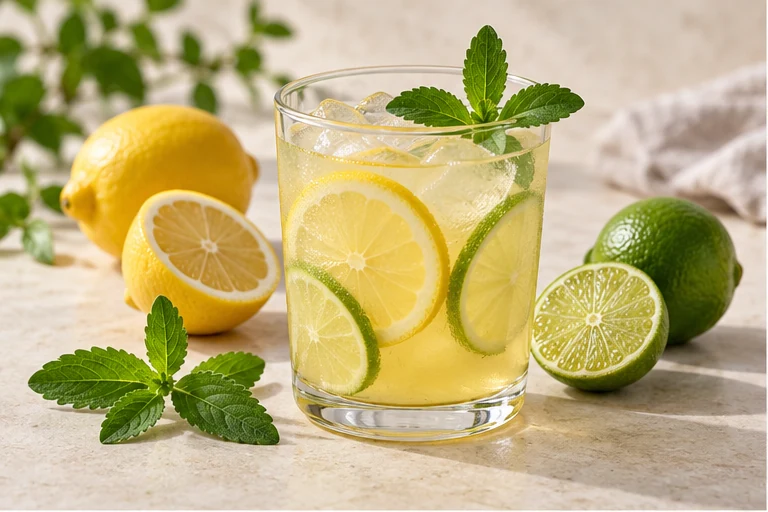
- Reduced-sugar citrus drink · Reb M/D-rich glycosides supply the sweetness gap; retained sucrose supplies part of the sweetness and dissolved solids
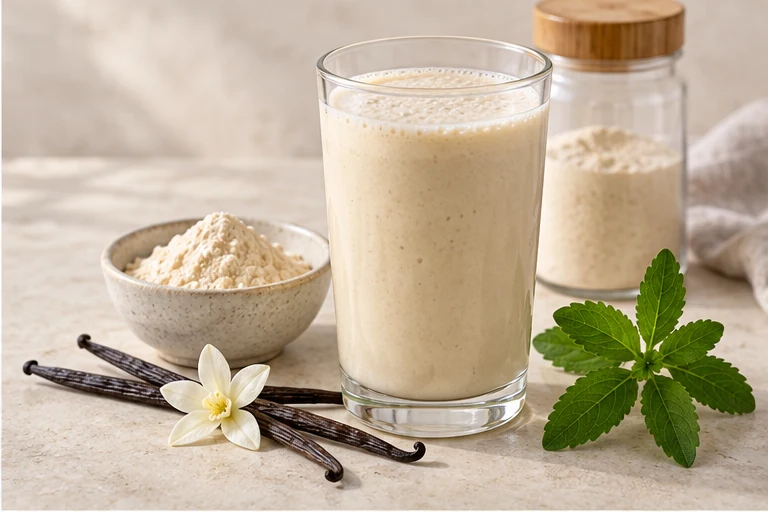
- Reduced-sugar vanilla protein drink · A selected glycoside blend supplies sweetness while milk or plant protein defines the product
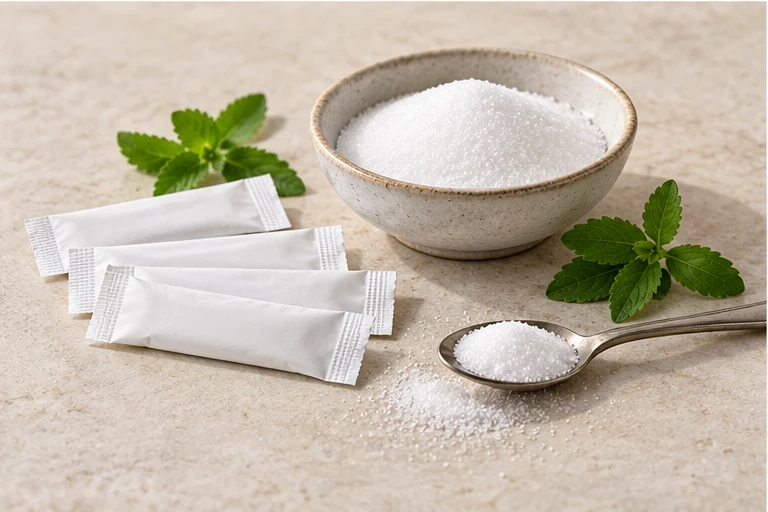
- Portioned tabletop sweetener sachet · Purified glycosides provide high-intensity sweetness; erythritol supplies bulk and additional sweetness, with D-psicose/allulose an optional co-bulking sweetener only where permitted
End-product selection
Reduced-sugar beverages, baked foods and tabletop sweetener blends.
Sweetness-system development for beverages, dairy/protein foods, baking and powder blends.
Three product development plans
These are pilot-development proposals. Ingredient roles, addition order and acceptance tests must be qualified in the final product.
Reduced-sugar citrus drink
Reb M/D-rich glycosides supply the sweetness gap; retained sucrose supplies part of the sweetness and dissolved solids. Citric acid sets tartness, citrate is a candidate buffer, and citrus flavour supplies aroma. Water is the continuous phase. Screen a second glycoside profile before adding more flavour to hide bitterness.
Prepare an unsweetened base and a full-sugar control. Dissolve the retained sucrose in the main water phase. Separately make a weighed, diluted glycoside stock at the supplier-supported concentration and temperature, then add it gradually under agitation. Add pre-diluted citrate/acid, adjust final mass and measure pH; add flavour at a stage compatible with the chosen heat process. If carbonated, chill and carbonate after blending in a closed system. Compare sweetness again at serving temperature and carbonation, not just in warm bench solution.
Use a sucrose control, a reduced-sugar control without glycosides, and two glycoside-profile candidates adjusted to matched sweetness. Hold acid system and flavour constant. Track time-intensity and bitter/metallic/licorice notes, pH, haze, sediment and the glycoside profile after the intended heat treatment and cold/ambient storage. Check the stock as well as the diluted drink for precipitation. Accept only against predefined reference-based sensory and physical limits; these tests do not establish microbial shelf life.
Reduced-sugar vanilla protein drink
A selected glycoside blend supplies sweetness while milk or plant protein defines the product. Retained sugar supplies some solids; a selected hydrocolloid controls suspension/body and an emulsifier is considered if the recipe contains a dispersed oil phase. Vanilla flavour supports the intended aroma but is not assumed to eliminate protein bitterness. Do not assume the protein, stabilizer and sweetener are compatible simply because each is food grade.
Hydrate the protein in the main water phase using its validated shear and temperature conditions. Predisperse the stabilizer in an appropriate dry carrier and hydrate separately or by its supplier procedure before combining. Add a fully dissolved glycoside stock and the remaining soluble ingredients; introduce the oil/emulsifier phase if used, then homogenize and apply the selected validated heat treatment. Add heat-sensitive flavour only through a permitted hygienic route. Reweigh after processing and compare pre- and post-heat samples.
Keep protein source, mineral load, pH and heat history fixed in the first screen. Assess protein sediment, creaming, viscosity, particle size and sweetness after heat and storage. Separate intrinsic protein bitterness from glycoside aftertaste using an unsweetened base and a sucrose reference. A dose increase that raises sweetness but also bitterness is not an improvement. Confirm no unacceptable sediment, viscosity drift or sensory penalty against written product targets; do not infer UHT stability or shelf life from room-temperature hand mixing.
Portioned tabletop sweetener sachet
Purified glycosides provide high-intensity sweetness; erythritol supplies bulk and additional sweetness, with D-psicose/allulose an optional co-bulking sweetener only where permitted. A permitted flow aid is considered only after powder tests demonstrate a need. Patent Example 8 discloses Reb M with erythritol and D-psicose; this is a documented composition example, not independent proof that the blend is optimal.[3][8]
Sieve and characterize the powders before weighing. Build a small glycoside-carrier preblend by geometric dilution, then add it in stages to the remaining bulk sweetener. Establish blend time by sampling rather than running indefinitely. Sample the blender, discharge stream and filled sachets after transfer; use dust containment and a verified micro-ingredient balance. If segregation persists, evaluate agglomeration and repeat dissolution and sensory tests rather than merely extending mixing time.
Compare particle size and density, moisture pickup, flow and post-vibration segregation. Assay glycosides per sachet as well as mean fill mass; a consistent total bag weight can hide unequal sweetness. Test dissolution and perceived cooling in both hot tea and cold water, followed by sweetness onset and lingering aftertaste. Declare the entire ingredient list and assess carrier tolerance and jurisdictional use conditions. Do not market the sachet as pure stevia or assume that the patented formula establishes current allulose authorization.
Sachet content: read weight and concentration together
A consistent fill weight does not by itself establish a consistent glycoside amount. Record three values for the same sachet: net powder mass (g), the named glycoside concentration on an as-received basis (mg/g), and glycoside amount (mg/sachet).
Glycoside amount (mg/sachet) = net powder mass (g) × concentration (mg/g).
For a unit-conversion example—not a measured sample—a 2 g sachet at 1% w/w contains 20 mg of the named glycoside. Here, 1% w/w means 10 mg/g. In the CSV, enter 1 with % w/w; as_received, or 0.01 with g/g; as_received; these are two ways to record the same concentration. An assay already reported as mg for the whole sachet should not be multiplied by the sachet weight again. Convert a dry-basis result to the as-received basis before using this equation.
Read the three values together: changing weight with similar concentration points first to filling or weighing; similar weight with changing concentration calls for a closer look at sampling, analysis and the production stage. Neither pattern alone proves segregation.
Whole sachet or a portion?
Before filling, segregation in bulk powder could change the composition delivered to different sachets. After sealing, particle rearrangement alone cannot change the total glycoside amount in an intact sachet with no material loss or degradation. For whole-sachet use, measure whole-sachet recovery. For partial use, measure the portion actually removed and record its mass, position and removal method; do not extrapolate that portion to the whole sachet without evidence that it represents the entire contents.
A useful sampling map is blender locations → discharge mass intervals → receiving hopper or bulk transfer → individual filled sachets. Keep filling order and refill or restart events with each sample. For destructive transport comparisons, randomly allocate different sachets from the same production interval to transported and untransported groups; link them with a group ID rather than treating them as the same bag measured twice.
One sachet is not several independent samples
Use sample_id for the physical sample, prep_id for each separately prepared analytical portion and injection_id for each instrument injection. Several injections from one preparation are still measurements of one physical sample. Thermo’s commercial-stevia application note, for example, reports two injections per sample—not two independently sampled sachets.10
Keep the sampling hierarchy when comparing net mass, concentration and mg/sachet. Agree sample numbers and decision rules with the laboratory before collection; repeat injections do not increase the number of independent bags.
Use the blank sampling record and material-characterization sheet, with the CSV filling guide. The material sheet keeps Dv10/Dv50/Dv90, dispersion conditions and the three density measurements separate. HORIBA’s commercial-sweetener study assessed dispersion pressure for each sample before reporting particle size, illustrating why measurement conditions belong beside the result.11
Processing and equipment
Leaf extraction recovers existing glycosides; selective crystallization changes proportions. A minor-glycoside target may instead involve enzyme conversion or fermentation with distinct residual and regulatory checks. Sugar replacement also needs solids/texture design.[7] [8] [34]
FSANZ A1268 describes four manufacturing approaches: extraction from leaves, microbial fermentation, enzymatic conversion of major to minor glycosides, and enzyme-catalysed glucosylation that adds further glucose units.[2] Leaf extraction recovers glycosides already in the plant; purification removes co-extractives. Targeted conversion starts with an existing glycoside substrate and changes its sugar substitution. Direct fermentation makes glycosides from simple carbon feed through a production organism. Extended glucosylation produces a distribution that must not automatically be labelled pure Reb M.[1][2]
An enzyme manufactured by fermentation can be used later to convert leaf-derived glycosides. That does not make the final glycoside a product of direct fermentation from sugar. A1268 concerns three enzymes from GM E. coli K-12 for bioconversion; FSANZ approved the draft variation on 25 October 2023 and issued the approval report on 3 November 2023.[2] Keep production-enzyme identity, substrate identity and final glycoside identity in separate records.
Avansya’s application dated 18 December 2020 describes Reb MD made with Yarrowia lipolytica, including fermentation followed by heat treatment, cell separation, optional ultrafiltration, resin adsorption, ion exchange, decolorization and crystallization.[1] This is an applicant manufacturing dossier, not independent confirmation of every factory performance claim and not proof that filing an application equals approval. Proposed process development should balance feed, intermediate glycosides, isolated product and losses; a high conversion result is incomplete without downstream recovery.
The A1222 process uses clarification for solids, optional ultrafiltration for dissolved nitrogenous material, adsorption and ion exchange for purification, and crystallization for product recovery.[1] Proposed equipment qualification should measure product in both clarified liquid and removed solids; for a membrane, compare protein removal with glycoside recovery and flux over a full run. A membrane rating alone does not prove separation of every similarly sized glycoside.
For a proposed leaf line, use extraction vessels and solid-liquid separation before purification. For a fermentation line, qualify the seed/fermentation vessels and cell-removal train; for conversion, qualify the reaction vessel and enzyme removal against actual substrates and protein burden. These are engineering recommendations derived from the distinct manufacturing routes, not one universal equipment list.[1][2] Record resin breakthrough, elution cuts, color, conductivity and glycoside mass. During crystallization, assay crystals and mother liquor separately and trend the effect of recycle.
Concentrate preparation needs an agitated, temperature-controlled make-up tank and accurate weighing; powder sachets need micro-dosing, controlled blending and verified filling. Set hold time, cleaning and sampling from product trials. No tank size, membrane area, solvent consumption or cost saving is assigned here because the public evidence does not establish an equipment design basis for the proposed products.
Quality and safety
A1222 specifies at least 95% total steviol glycosides for its purified Reb MD material and provides individual-glycoside analytical information.[1] This percentage is not a universal requirement for an erythritol-based retail blend. A proposed certificate of analysis should state identity, dry/as-is basis, named glycosides counted in the total, individual proportions, moisture, microbiological results and process-relevant residues. Require an analytical method that actually covers the purchased composition; a large unidentified peak should not disappear into a total.
The A1222 dossier recounts the JECFA ADI of 0–4 mg/kg body weight per day, expressed as steviol, and lists molecular weights of steviol, Reb A and Reb M.[1] Illustrative exposure calculation: 100 mg pure Reb A × 318.46/967.01 is about 32.9 mg steviol equivalents; 100 mg pure Reb M × 318.46/1291.3 is about 24.7 mg. This is arithmetic, not an intake recommendation. Sum each glycoside’s contribution across relevant foods, account for actual assay and divide by body weight before comparison with the ADI.
A route change calls for renewed comparison of profile, residues, dissolution and labeling evidence. Residual solvents should follow the actual purification history; absence of smell is not an analytical result. For enzyme or fermentation ingredients, obtain production-organism and residual protein/DNA control evidence appropriate to the assessed route.[1][2] FDA’s alert is specific to its US regulatory context and distinguishes dietary supplements from conventional foods.[5] A full current China/EU food-category and route-permission crosswalk was not completed; confirm it before launch.
Buy this ingredient: specifications, COA, certification documents & pricing →
Practical questions
Can Reb M replace Reb A at the same powder dose? Do not assume so. Individual composition and the final food matter; compare at matched sweetness and retest dissolution and storage behaviour.[1]
Does fermentation mean live engineered organisms are added to the drink? The manufacturing route and final purified material are separate. A1222 describes organism removal and downstream purification, while A1268 assesses enzyme processing aids for conversion.[1][2] Ask for final-product controls rather than inferring either presence or absence of residues from the word fermentation.
Is a stevia drink automatically sugar-free or suitable for a diabetes claim? No. Its complete recipe determines sugar content, including retained sugar and carriers; the cited human studies do not establish treatment of diabetes.[6][7] Measure the finished product and review the exact label claim.
Why can a compliant batch still taste different? Total assay can conceal differences in individual glycosides. The applicant dossier allows compositional variation and describes crystallization and blending.[1] Proposed troubleshooting compares the fingerprint, stock preparation, dose uniformity, acid balance and storage history before raising the dose.
Research cases
Enzymatic and fermentation research changes access to minor glycosides. The 2021 biosynthesis review and the two FSANZ document sets provide complementary scientific and process contexts.[37][8][7] Titer, productivity, conversion, target proportion and downstream recovery must be considered together: richer target composition may simplify crystallization, while cell/protein/medium removal creates additional load.
| Role | Handover | Error avoided |
|---|---|---|
| R&D | Matched-sweetness profile and stored composition | Purity ranking as application selection |
| Engineering | Complete feed/product balance, mother liquor and solvent circuit | Upstream yield hiding downstream loss |
| Procurement | Route, individual ranges, carrier and use cost | One generic stevia quotation for different materials |
| QA | Method coverage, residuals, authorization match and changes | Unlimited extrapolation of a GRAS/JECFA record |
| Brand | Accurate glycoside and origin wording | Calling fermentation direct leaf extraction or universally bitterness-free |
Evidence limits: the 2025 leaf paper was available at abstract level; its yield percentages were not used. Fermentation conditions come from a full applicant dossier without public vessel size. Broad health language in the 2024 review was not adopted. No company capacity, universal optimum or therapeutic/glucose-management claim is made.
Relevant patents
US20140342043A1
A1 published application. Original applicant/assignee: PepsiCo, Inc.. Priority / filing / publication: 2013-05-14 / 2013-05-14 / 2014-11-20.[8]
Published claim 1: food with a sweetening amount of Reb M and another food ingredient. Independent claim 9: beverage with water, flavoring and a Reb M sweetener component. Independent claim 25: Reb M plus another edible ingredient. Dependent claim 14 limits a carbonated diet cola to pH >3.0 and <4.0 and Reb M between 50 and 600 ppm. These are published application claims, not a granted universal monopoly on stevia.[8]
Food-product composition and co-sweetener design, distinct from the enzyme-production family below.[8]
US11274328B2
B2 granted US patent. Original applicant/assignee: Sichuan Ingia Biosynthetic Co., Ltd.. Priority / filing / publication: 2018-09-29 / 2019-09-30 / 2022-03-15.[9]
Granted claims 1 and 2 start with Reb A and/or stevioside, use respectively recombinant microorganisms or their enzyme preparation expressing Oryza sativa EUGT11 and Stevia rebaudiana UGT76G1, and purify Reb D and/or Reb M. They require the specified E. coli or Pichia pastoris hosts and gene modifications: pgm/glgC/agp knockouts and, for E. coli, ushA replacement with a T5 operon containing Basp and ugpA. Claims 3/4 add sucrose and trisodium citrate. This is not every enzyme route and not de novo fermentation from sugar alone.[9]
Starting glycoside conversion, host/enzyme definition and recovery; relevant to supplier route diligence rather than beverage blending permission.[9]
References
- FSANZ A1222: Reb MD applicant dossier · 2026-09-11
- FSANZ A1268: approval report for enzyme processing aids · 2026-09-11
- stevia-patent-composition · 2026-09-11
- stevia-patent-process · 2026-09-11
- FDA: stevia import alert · 2026-09-11
- Twelve-week stevia consumption trial (2020) · 2026-09-11
- Anton et al.: stevia, aspartame and sucrose meal comparison (2010) · 2026-09-11
- USPTO published application US20140342043A1 primary PDF · 2026-09-11
- USPTO granted patent US11274328B2 primary PDF · 2026-09-11
- Thermo Scientific: Analysis of Products Containing Stevia · 2026-09-20
- HORIBA: Particle Size Analysis of Sugar Substitutes · 2026-09-20
Material and processing background sources
- JECFA — Steviol glycosides · 2026-09-09
- APPLICATION FOR THE APPROVAL OF STEVIOL GLYCOSIDES FROM YARROWIA LIPOLYTICA UNDER THE AUSTRALIA NEW ZEALAND FOOD STANDARDS CODE – STANDARD 1.3.1 – FOOD ADDITIVES · 2026-09-09
- Approval report – Application A1268 · 2026-09-09
- Import Alert 45-06 · 2026-09-09
- Properties, extraction and purification technologies of Stevia rebaudiana steviol glycosides: A review - ScienceDirect · 2026-09-09
- Ultrasound-Assisted Coupled with Resin-Based Purification for Sustainable Extraction of Steviosides from Stevia rebaudiana Leaves · 2026-09-09
- Synthesis and production of steviol glycosides: recent research trends and perspectives · 2026-09-09