Material identity
Lycium barbarum fruit. Whole-fruit powder, juice solids, polysaccharide fractions and carotenoid-oriented materials must remain distinct; leaf studies do not identify fruit extracts.
Whole-fruit powder, juice powder, crude aqueous extract, free-sugar-depleted polysaccharide concentrate, molecular-weight fractions and carotenoid-oriented ingredients require separate identity records. Whole-fruit tissue particles differ from juice solids, and polysaccharide refining intentionally changes sugar, protein, phenolic and pigment proportions. An original fractionation study obtained three size fractions with differences in monosaccharides, proteins, polyphenols and biological responses even where total sugars were similar.[24] Fruit origin and high total sugar therefore do not identify a particular polysaccharide.
A processing review treats polysaccharides, betaine and carotenoids as separate chemical families and discusses distinct processing routes.[12] Choose material according to the application: juice powder for fruit flavor/color/reconstitution, enriched/fractionated material for polysaccharide consistency, and a separate pigment-assay/stability program for zeaxanthin delivery. Leaf-polysaccharide papers cannot automatically support fruit-polysaccharide specifications; plant part is a material process variable.
Effects and human research
| Type | Material, scale and conditions | Finding/use | Not equivalent to |
|---|---|---|---|
| Randomized unmasked human pilot, 2021 | 31 randomized; 28 completed; 27 reportedly analyzed (13 goji, 14 comparator), aged 45–65; 28 g whole berries five times/week for 90 days.[13] | Within-goji-group MPOD increases at selected retinal eccentricities; no significant treatment-by-time interaction.[13] | AMD-incidence prevention or a polysaccharide substitution study[13] |
Goji berry extract, juice powder and polysaccharides: what differs?
Free sugars, polysaccharide size/composition, betaine and carotenoids are separate targets.
Goji berry extract is not a single material specification. Juice powder is selected for fruit solids, flavour and reconstitution; a polysaccharide-rich fraction needs a defined carbohydrate profile. Whole-fruit powder retains tissue particles, while carotenoid-focused ingredients require a separate pigment assay and stability assessment. A total-sugar result does not identify a polysaccharide fraction.[12][24]
Application selection
Beverages/instant powders—proposals. Test the marketed powder, not a laboratory sugar-free fraction, at fixed loading, water temperature and mixing energy. Record wetting, lumping, clarity, sediment and color. Insoluble fiber in whole-fruit powder is not automatically a juice-powder defect; substantial sediment in a declared clear-juice powder, however, calls for an identity/process investigation. Both fruit sugars and carriers contribute soluble solids, but have different implications for declared fruit content and should be calculated separately.
Gummies—proposals. Run separate juice-powder and polysaccharide-concentrate series with comparable total soluble solids or water content before comparing gel strength, tack, color, water activity and storage changes. Juice sugars alter solids balance, while polymer fractions may change viscosity and gel structure. Equal ingredient percentages are not functional equivalence. “Late addition protects activity” is insufficient without validating addition temperature, holding time, mixing uniformity and microbial control.
Higher-value polysaccharide products. For rheological or research-fraction applications, test concentration-dependent flow, salt/pH response, freeze/thaw and post-heating molecular-weight profiles. Sugar removal, deproteinization, ultrasound and heat can change the mixture. The original fractionation study found that different fractions did not rank identically across ORAC, ABTS and zebrafish immune models.[24] Choose the response relevant to the product—such as dispersibility, low viscosity or profile retention—instead of automatically maximizing molecular weight.
Carotenoids and eye-health education. Whole-fruit human studies and isolated-polysaccharide cell studies belong in separate evidence columns. A randomized, unmasked pilot reported an analysis of 27 adults aged 45–65 consuming 28 g berries five times weekly for 90 days, compared with a supplement containing 6 mg lutein and 4 mg zeaxanthin; endpoints included macular pigment optical density.[13] It did not test low-dose juice powder, depigmented polysaccharide capsules or disease incidence. Explain fruit pigments and water-soluble polysaccharides as distinct research paths rather than joining red color, polysaccharide percentage and clinical eye outcomes into an unsupported causal chain.
The 2021 trial (DOI 10.3390/nu13124409; PMID 34959963) reports 31 randomized and 28 completers in Figure 1; its figure caption gives 27 analyzed (13 goji, 14 comparator). The abstract uses 27 participants, while the Results exclusion narrative is not arithmetically consistent with that caption. Treat 27 as the reported analysis count, not the randomized sample. Its significant MPOD findings were within-group changes at selected retinal eccentricities and do not alone demonstrate superiority to the comparator or prevention of AMD.[13]
- Goji instant drink sachet · Use declared goji juice powder for fruit flavor and color; its existing carrier contributes bulk and must be counted
- Goji fruit gummy · Juice powder supplies fruit solids and flavor
- Defined polysaccharide-fraction capsule · Use one characterized fruit-derived, free-sugar-depleted fraction as the identity-controlled payload
End-product selection
Instant drink powders, juice-based gummies and polysaccharide powder concepts.
Fruit-flavour foods and drinks, gummies and separately characterized research fractions.
Three product development plans
These are pilot-development proposals. Ingredient roles, addition order and acceptance tests must be qualified in the final product.
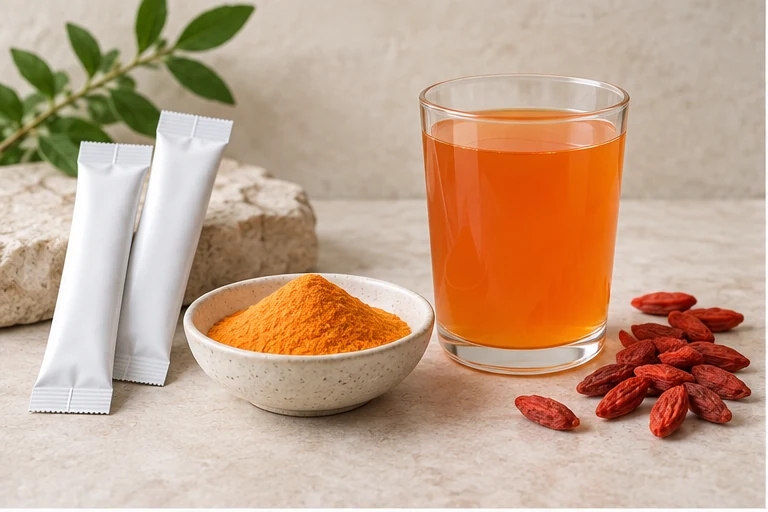
Goji instant drink sachet
Use declared goji juice powder for fruit flavor and color; its existing carrier contributes bulk and must be counted. Use a neutral soluble base only if needed for flow and portion size. An acidulant adjusts taste; it is not evidence of preservation. Keep a carrier-only control.
Check the supplier carrier declaration and sieve compatible dry ingredients separately. Premix minor acid/flavor components into part of the base, then blend in juice powder and remaining base. Sample several blender locations before filling moisture-barrier sachets. Reconstitute at the intended serving dilution and test both cool and warm water.
Screen acid level against flavor, color and sediment rather than selecting pH from another fruit. Record wetting, lumps, soluble solids, color, moisture uptake, water activity and packed storage. Reconcile fruit-solids and carrier masses; neither total soluble solids nor a total-sugar assay is a polysaccharide claim. Set sensory and reconstitution acceptance criteria before the trial.
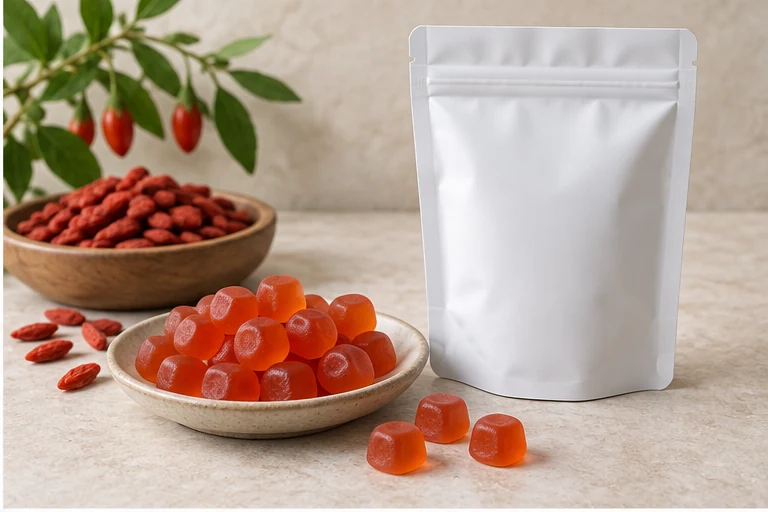
Goji fruit gummy
Juice powder supplies fruit solids and flavor. A selected food-grade pectin grade supplies the gel network; sugar or syrup sets the solids balance, water enables hydration, and acid sets final taste and the grade-specific gel conditions. The goji ingredient is not assumed to replace pectin.
Predisperse and hydrate pectin according to its grade. Prepare the syrup and establish the solids target. Incorporate a separately dispersed juice powder under controlled mixing; add acid at the point appropriate to the selected gel system. Deposit, set and condition before packing. Validate temperature and hold time around goji addition rather than using late addition as a substitute for microbial control.
Compare a no-goji control and juice-powder trials at matched water/solids balance. Measure depositability, setting time, gel strength, tack, syneresis, color, water activity and storage. If an enriched polysaccharide is also studied, run a separate series and measure viscosity; equal mass does not establish functional or clinical equivalence.
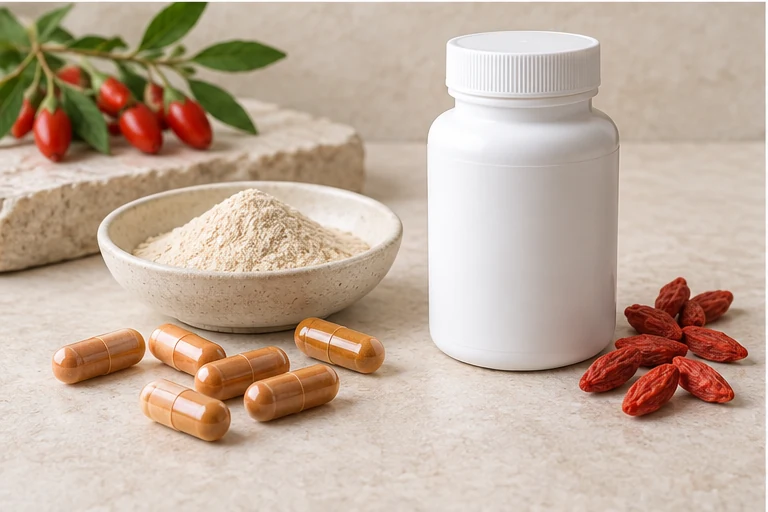
Defined polysaccharide-fraction capsule
Use one characterized fruit-derived, free-sugar-depleted fraction as the identity-controlled payload. A compatible filler sets fill mass; a permitted glidant can be screened for flow. The shell contains the blend, but does not demonstrate release. Keep the fraction identity separate from the patented glycopeptide composition and from carotenoid-rich whole berries.[7][24]
Confirm extraction history, residual-solvent controls and molecular-weight profile before blending. Condition and sieve without assuming aggressive milling is harmless. Geometrically dilute with filler, add any glidant at a defined final mixing stage, check uniformity, then encapsulate and barrier-pack. Test release using a method shown to recover the target fraction.
Track free sugars, protein/polyphenol profile where relevant, molecular-weight distribution, moisture, flow and blend uniformity. Check shell compatibility and disintegration separately from analytical recovery of the polymer. Compare the ingredient and released fraction after storage. Neither cell/zebrafish results nor a whole-fruit MPOD trial validates a capsule health claim.[13][24]
Processing and equipment
Juice powder targets flavour, colour and reconstitution without removing all sugars. A polysaccharide concentrate instead requires sugar removal and fractionation; a zeaxanthin target needs a separate pigment recovery and stability plan.[9] [37]
Route A—proposed juice-powder engineering. Sort/wash fruit → pulp or press → choose coarse screening, centrifugation or clarification for the intended clear/cloudy juice → independently validated microbial control → optional low-thermal-load concentration → carrier mixing/homogenization → drying → moisture-protective packaging. The objective is acceptable flavor, color, reconstitution and storage, not removal of all native fruit sugars. Clarification can alter the suspended tissue and its associated constituents, so clear versus cloudy juice should appear in the identity. A verifiable original goji-juice spray-drying process paper was not obtained; no claimed goji-specific optimum inlet temperature, carrier loading or powder yield is supplied.
Route B—an actual crude-polysaccharide/fractionation experiment. A 2023 original study used authenticated berries purchased in Zhongning, Ningxia. Fruit was extracted twice with purified water, supernatants were collected by centrifugation and concentrated. Adding 95% ethanol to a final 50% ethanol concentration followed by overnight holding produced a precipitate that was discarded. The remaining liquid was adjusted to 85% ethanol; after 12 hours the precipitate was collected, redissolved, deproteinized by the Sevag method, concentrated and freeze-dried.[24] The discarded and retained streams must not be reversed, and adding an 85% ethanol solution is not the same as reaching 85% final ethanol. Analytical-grade solvents/deproteinization are research preparation details, not automatically food-production operations.
The researchers dissolved 10 g crude polysaccharides in 60 mL water. A 1 kDa ultrafiltration tube removed monosaccharides/some oligosaccharides; 3 and 10 kDa tubes then produced 1–3, 3–10 and >10 kDa fractions, which were freeze-dried as LBPs-1/2/3.[24] This is a gram-scale tube separation, not an industrial membrane plant. HPSEC-RID-MALLS subsequently measured approximately 1.912, 7.481 and 46.239 kDa. Nominal membrane cutoffs and measured molecular weights are distinct outputs.[24]
The study compared three ultrasound modes at 20 g fruit powder/600 mL water, 60°C for 30 minutes, 300 W/L, and 5 seconds on/2 seconds off. Reported crude-polysaccharide yields were 38.93% for counterflow dual-frequency ultrasound at 20/40 kHz, 33.60% for opposite-sit dual-frequency ultrasound at 16/20 kHz, and 26.38% for counterflow single-frequency ultrasound at 28 kHz. These are laboratory crude-recovery values, not purified-polysaccharide content or industrial capacity.[18]
| Equipment | Function | Variables/failures | Material and scale |
|---|---|---|---|
| Pulper/press/coarse screen | Release juice and control tissue particles | Size, seed/skin carryover, air entrainment, cleaning | Proposed juice route |
| Heated stirred extraction vessel | Water extraction of polysaccharide-related material | Time/temperature, ratio, viscosity, solid/liquid recovery | Two aqueous extractions are documented; tank design is proposed[24] |
| Laboratory ultrasound modes; scale-up unit to be selected | Cavitation and enhanced contact | Frequency pair, pulse timing, cooling, field geometry and circulation | Laboratory comparison: 20/40 kHz counterflow dual, 16/20 kHz opposite-sit dual, and 28 kHz counterflow single; operating conditions described above.[18] |
| Ethanol precipitation vessel/separator | Change solvent quality to fractionate macromolecules | Final ethanol, addition rate, mixing, temperature, maturation | Research 50%/85% fractionation; industrial translation unvalidated[24] |
| Ultrafiltration/diafiltration | Remove small molecules and concentrate larger material | Membrane, pressure, flux, polarization, fouling | Original 10 g/60 mL tubes; tangential flow is a scale-up candidate[24] |
| Spray dryer / freeze dryer | Juice-powder processability / research-fraction preparation | Adhesion/carrier dilution versus cycle/collapse/moisture uptake | Freeze drying documented for fractions; juice spray settings not obtained[24] |
| Anion-exchange/size-exclusion columns | Isolate charge- and size-defined research material | Loading, pooling, desalting, dilution and yield | Used for a 13.72 kDa acidic heteropolysaccharide; abstract lacks input mass[21] |
Engineering proposals. Ultrafiltration does not automatically purify one polysaccharide. Retention depends on hydrodynamic size, shape and membrane interactions; changing membrane chemistry at the same nominal cutoff requires renewed permeate/retentate sugar profiles, molecular-weight distributions and recoveries. Water flux does not establish performance with viscous polysaccharide feed. Record flux per membrane area against concentration factor before sizing membrane area and cleaning cycles. During constant-volume diafiltration, track free-sugar removal rather than only wash-water input.
Excessive dilution before precipitation increases ethanol and recovery duty, while excessive concentration impairs mixing; use a viscosity/concentration curve to find an operating window. Residual protein is not always simply irrelevant impurity: some studied fractions contain protein/phenolic-associated components. Stronger deproteinization or decolorization should therefore be assessed for changes to the intended material profile.[24] Report what was removed, retained and changed in performance, rather than merely claiming improved purity.
Quality and safety
The original fractionation paper measured total sugars by phenol–sulfuric acid with glucose calibration, separately measured protein/polyphenols, and used HPAEC-PAD for monosaccharide composition, HPSEC-RID-MALLS for molecular weight, and FTIR/NMR for structure.[24] That combination is itself instructive: total sugar is only one entry in the chemical balance. Free-sugar removal, carriers, size distribution and building-block composition are needed to describe a polysaccharide material. Direct colorimetry of untreated juice powder risks counting free sugars and maltodextrin; this requires specific separation/spike validation rather than assuming the assay is selective.
| Test | Juice powder | Enriched/fractionated material | QA interpretation |
|---|---|---|---|
| Identity/composition | Juice versus whole fruit, clarity, carrier | Fruit part, sugar/protein removal and fractionation | Name the actual stream |
| Sugar assay | Free sugars and carriers separately | Pretreated total sugar plus residual small sugars | Glucose equivalents are not mass of a unique goji polymer; blanks/recovery matter[24] |
| Molecular weight | Usually secondary to flavor-powder function | Distribution, averages and system | MWCO is not a measurement; calibrated SEC and MALS outputs are not automatically interchangeable[24] |
| Monosaccharides | As required by intended use | Post-hydrolysis batch profile | Building blocks alone do not establish linkage sequence[21][24] |
| Carotenoids | Separate assay/protection if central to positioning | Cannot be inferred from polysaccharide percentage | Whole-fruit clinical evidence is not depigmented-fraction evidence[13] |
| Physical/storage | Moisture uptake, caking, color, reconstitution, water activity | Reconstitution, viscosity and size retention | Test realistic humidity and packaging |
A proposed comparability protocol requests results before and after small-sugar removal, a carrier blank and recovery data. With maltodextrin-containing powder, confirm whether pretreatment also retains the carrier; ethanol precipitation does not automatically exclude it. Record hydrolysis reagent/time/temperature, detector and standards. Size-dependent dissolution or filter losses can bias pretreatment and should enter method uncertainty. Food/extract contracts also require destination-specific contaminant, microbiological, sulfite-treatment and labeling review. Set contaminant, microbiological and labeling requirements for the defined material and destination market.
Buy this ingredient: specifications, COA, certification documents & pricing →
Practical questions
Can juice powder be substituted for a purified polysaccharide? No. Match plant part, extraction history, carrier, free sugars and measured size profile first; total sugar alone cannot establish identity.[24]
Does a 1 kDa membrane mean a 1 kDa ingredient? No. The fractionation experiment reported nominal membrane intervals and separately measured 1.912, 7.481 and 46.239 kDa fractions. A cutoff is an operating specification, not the measured mass of every molecule.[24]
Does the eye-health trial prove that goji polysaccharide capsules prevent AMD? No. It studied whole berries and a carotenoid comparator for 90 days, with MPOD as a measured endpoint, not disease incidence. It did not test the proposed capsule.[13]
The 38.93% crude recovery belongs to the 20/40 kHz counterflow dual-frequency mode; the 28 kHz single-frequency mode yielded 26.38%.[18]
Which universal specification should a buyer use? This evidence set does not establish one legal specification covering juice powder, whole-fruit powder and refined fractions. Set identity and intended-use tests, then review destination-market safety, labeling and permitted claims before sale.
Research cases
| Type | Material, scale and conditions | Finding/use | Not equivalent to |
|---|---|---|---|
| Original fractionation/structure/activity, 2023 | Zhongning fruit; 10 g crude fraction/60 mL; 1/3/10 kDa tubes | 1.912/7.481/46.239 kDa fractions differ structurally and biologically | Juice powder or industrial membrane yield[24] |
| Original multimode ultrasound | 20 g fruit powder/600 mL water; 60°C, 30 minutes, 300 W/L; 5 seconds on/2 seconds off.[18] | Crude yields: energy-aggregation counterflow dual-frequency 38.93%; opposite-sit dual-frequency 33.60%; energy-aggregation counterflow single-frequency 26.38% | Pure-polysaccharide content or ton-scale capacity[18] |
| Original structure/cell study, 2022 | Anion exchange plus size exclusion; LICP009-3F-2a, 13,720 Da; input scale unavailable in abstract | Acidic heteropolysaccharide active in ARPE-19 oxidative/high-glucose injury models | Human visual benefit or ordinary juice-powder performance[21] |
Relevant patents
US11110144B2
B2 granted patent publication. Original applicant/assignee: Shanghai Institute of Organic Chemistry, Chinese Academy of Sciences. Priority / filing / publication: 2018-07-30 / 2018-07-30 / 2021-09-07.[7]
Granted claim 1 is a water-only preparation method: soak wolfberry fruit and centrifuge; heat the first extract to flocculate insolubles and centrifuge to a second extract with at least 50% transmittance at 400 nm; ultrafilter using a 1000–2000 Da cutoff, concentrate and dry the retentate (the patent’s “cut-off solution”). Claim 11 adds continuous water supply during ultrafiltration and collection when conductivity is below 1000 us/cm and sugar degree below 1.2. These are claim limitations, not general goji specifications.[7]
A distinct glycopeptide process route for comparing clarification and small-solute removal. It does not establish equivalence to the ethanol/Sevag research fractions or efficacy for an instant drink. The A1 and B2 are one family, not two inventions. Google displays an expired-fee-related status; current enforceability and freedom to operate need official-register and legal review.[7]
CN105367678A
A invention application publication, not a verified grant. Original applicant/assignee: ZHENJIANG DANTU DISTRICT NANSHAN XIYUAN TEA PROFESSIONAL COOPERATIVES. Priority / filing / publication: 2015-12-03 / 2015-12-03 / 2016-03-02.[8]
Claim 1 sets out dried goji particles, enzymatic extraction and water extraction. Dependent claim 3 specifies powder:water 1:15, 40°C, “0.01% concentration” cellulase without an explicit concentration basis, 30 min and heating to 85°C for enzyme inactivation. Claim 4 states a further 1:2 water-addition step, 60°C for 80 min, 150-mesh filtration, centrifugation and drying; its “酶解茶多糖溶解液” (enzymatically hydrolyzed tea-polysaccharide solution) wording is an internal source inconsistency.[8]
A separate enzyme-assisted extraction family, useful for identifying enzyme inactivation and downstream separation questions. It supplies neither a verified commercial yield nor human efficacy. The retrieved record is an application publication; a displayed pending label is not confirmation of current prosecution status.[8]
References
- US11110144B2: wolfberry glycopeptide preparation · 2026-09-11
- CN105367678A: enzyme-assisted goji extraction (Chinese claims also checked) · 2026-09-11
- Bioactive components and deep-processing fermentation products (review) · 2026-09-11
- Goji berry intake and macular pigment optical density: randomized pilot trial (2021) · 2026-09-11
- Effect of multimode ultrasound assisted extraction on crude goji polysaccharide yield · 2026-09-11
- LICP009-3F-2a: structure and ARPE-19 cell study (2022; abstract) · 2026-09-11
- Comparative study of three molecular-weight fractions of Lycium barbarum (2023) · 2026-09-11
Material and processing background sources
- Bioactive Components of Lycium barbarum and Deep-Processing Fermentation Products - PMC · 2026-09-09
- A polysaccharide from Lycium barbarum L.: Structure and ... · 2026-09-09
- Effect of addition of maltodextrin on drying kinetics and stickiness of sugar and acid-rich foods during convective drying: experiments and modelling · 2026-09-09
- Comparative Study on the Structural Properties and Bioactivities of Three Different Molecular Weights of Lycium barbarum Polysaccharides · 2026-09-09
- Effect of multimode ultrasound assisted extraction on the yield of crude polysaccharides from Lycium Barbarum (Goji) · 2026-09-09
- Goji Berry Intake Increases Macular Pigment Optical Density in Healthy Adults: A Randomized Pilot Trial · 2026-09-09