Related study guide: ginseng bitterness after processing and masking across matrices →
Material identity
Panax ginseng roots. Fresh roots, dried white ginseng, steamed red ginseng and repeatedly steamed black ginseng have different processing identities; other Panax species and leaves are not interchangeable.
This article concerns the root of Panax ginseng C.A.Mey. White ginseng is dried root; red ginseng is steam-processed root. Their extracts need not have the same chemical profile. A 2024 phytochemistry review describes ginsenosides alongside polysaccharides, amino acids, polyacetylenes and compounds formed during steaming.[11][14]
For a drink, ginseng has to work as a flavour ingredient before its assay has much practical value. Bitterness is a documented formulation problem: one granted patent specifically addresses masking it in ginseng-containing foods. A capsule has a different job, with composition and consistent delivery taking precedence over the taste of a diluted cup.[1][12]
Start a development brief by naming the species, plant part, white/red/black processing history, extract solvent and supplied form. Treat a change of extract as a change of ingredient, rather than assuming that the same mass will produce the same composition. EMA lists distinct preparations by extraction solvent and drug-to-extract ratio.[11]
Root pieces and root powder retain the plant material. Use pieces for an infusion or decoction format and consider powder when the product can tolerate visible solids. EMA distinguishes comminuted root, powdered root, dry extracts, soft extracts and liquid extracts rather than treating them as interchangeable.[11]
A dry extract is useful when weighing and blending a powder product; a concentrate suits a liquid blending operation. Request the actual carrier content and the assay basis before comparing offers. The monograph describes one specific white-ginseng extract with 4% ginsenosides defined as the sum of named compounds; that definition should not be generalized to every total-saponin result.[11]
Red and black ginseng describe processing, not a universal potency ranking. Repeated steaming and drying can change ginsenoside composition. A black-ginseng process study also measured benzopyrene as a process-related quality concern, so darker colour or more Rg3 alone is not an adequate release decision.[13][14]
Effects and human research
A randomized, double-blind, placebo-controlled trial enrolled 90 adults with idiopathic chronic fatigue. Participants received a particular 20% ethanol Panax ginseng extract at 1 or 2 g/day, or placebo, for four weeks. These are study conditions, not suggested servings for a beverage or a substitute extract.[19]
The total numeric fatigue score did not improve significantly relative to placebo. Mental-fatigue scores improved in the ginseng groups, and the visual analogue fatigue score improved significantly only with the 2 g/day treatment. The short study does not establish treatment of chronic fatigue syndrome or an effect in healthy consumers.[19]
The study also measured blood markers related to oxidative stress. Changes in those markers are not evidence of disease prevention, and they do not establish which constituent caused any symptom change. Its extract was chemically characterized; a commercial material should not borrow its findings solely because the label says ginseng.[19]
EMA’s 2024 monograph places use for asthenia symptoms such as fatigue and weakness under traditional use, explicitly based on long-standing use. It does not list a well-established-use indication. This distinction matters when choosing consumer wording: a traditional herbal medicine indication is not blanket authorization for a food health claim.[11]
Material forms and composition
Individual ginsenosides, their malonyl precursors and heat-conversion products should be tracked separately from a total-saponin assay.
Individual ginsenosides, their malonyl precursors and heat-conversion products should be tracked separately from a total-saponin assay.
| Equipment/process | Intended task | Trade-off or risk | Acceptance output |
|---|---|---|---|
| Controlled steamer with graded tray loading | Preserves a whole-root red-ginseng processing identity | Root diameter, loading depth and cold spots change actual exposure | Root-core temperatures at mapped positions; heating/holding/cooling curves; matched fingerprints |
| Pressure thermal reactor | Explores high-temperature conversion | Desired conversion competes with further degradation; more complex pressure control and sampling | Acidity, moisture, actual history, precursor/product molar balance |
| Hot-air drying versus freeze drying | Conventional drying versus a low-thermal-exposure reference | Continued reaction and spatial variation versus cycle time and cost | Moisture/water activity distribution, colour, ginsenoside retention, energy |
| Jacketed water/ethanol extractor | Recovers constituents from roots with an already defined processing identity | Heat transfer at high solids, foaming/entrainment, solvent recovery | Actual solvent strength, residue markers, liquor composition, repeat-extraction benefit |
| Resin column or other fractionation pilot | Deliberate ginsenoside enrichment | Elution changes ratios and may remove acids or non-saponin fractions | Loading/breakthrough/elution/cleaning balances and relevant residues |
| Vacuum concentration and powder drying | Removes solvent and produces a measurable material | Acidity and residence time jointly affect profile; wall losses | Actual product temperature, residence distribution, before/after chromatography and solids yield |
| Blending and representative sampling | Multi-batch adjustment or carrier standardization | Average assay can hide local variation or mixed processing histories | Multi-position uniformity, genealogy, carrier balance and final assay |
Application selection
The three plans below are development concepts, not tested recipes or dosage recommendations. They separate a liquid drink, a reconstitutable powder and a capsule so that each plan has a clear material requirement. Establish permitted use and serving size for the target market before trial manufacture. The US supplement specification rule requires controls for identity, purity, strength, composition and relevant contamination; it is not permission to sell a particular ingredient in every food.[12]
For the first prototype, keep the ginseng source fixed and vary one support system at a time. Compare flavour, dispersibility and analytical recovery in the complete product, not only in the ingredient supplier’s water test. Set acceptance criteria before making the trial batches; the plans list the measurements needed.
- Ginseng citrus drink · Use a beverage-qualified ginseng extract as the botanical base, water as the continuous phase, a selected sweetener for taste balance and citrus flavour for aroma
- Ginseng ginger instant sachet · Select a dry ginseng extract with declared carrier content
- Single-botanical ginseng capsule · Use a defined dry ginseng extract as the botanical component
End-product selection
Ginseng drinks, liquid concentrates, capsules and tablets.
Beverages, concentrated liquids and oral-solid development.
Three product development plans
These are pilot-development proposals. Ingredient roles, addition order and acceptance tests must be qualified in the final product.
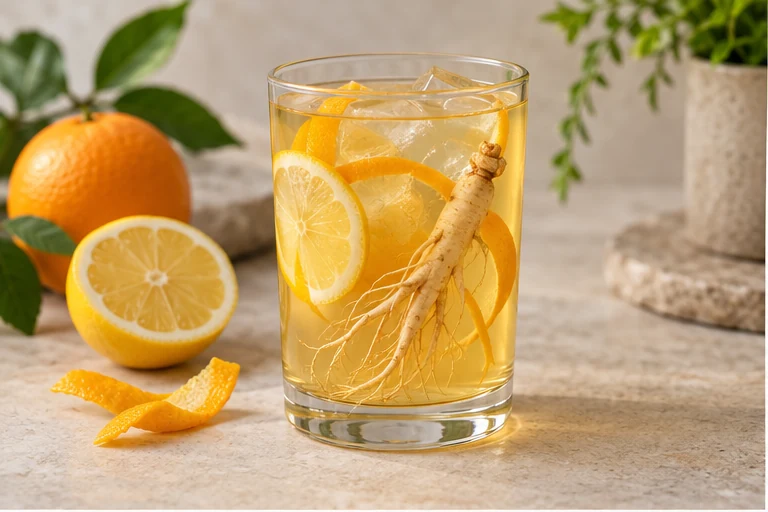
Ginseng citrus drink
Use a beverage-qualified ginseng extract as the botanical base, water as the continuous phase, a selected sweetener for taste balance and citrus flavour for aroma. Indigestible maltodextrin plus citrus extract is a patent-disclosed bitterness-masking option, distinct from simply adding citrus flavour. Screen it only after a freedom-to-operate review.[1]
Dissolve the ginseng extract separately in treated water and inspect for insoluble matter. Prepare the sweetener and any selected fibre solution separately, blend into the botanical base, then add diluted acid gradually and the chosen aroma at its suitable stage. Trial the complete beverage through the intended preservation and filling process. Do not regard acid addition alone as a validated preservation process.
Compare bitterness and aftertaste against the same ginseng base without the support system; also track haze, sediment, colour and marker recovery after processing and storage. Acid–heat effects on ginsenosides justify a profile check, but the laboratory conversion study supplies no ready-made beverage pH or shelf-life target.[21]
Ginseng ginger instant sachet
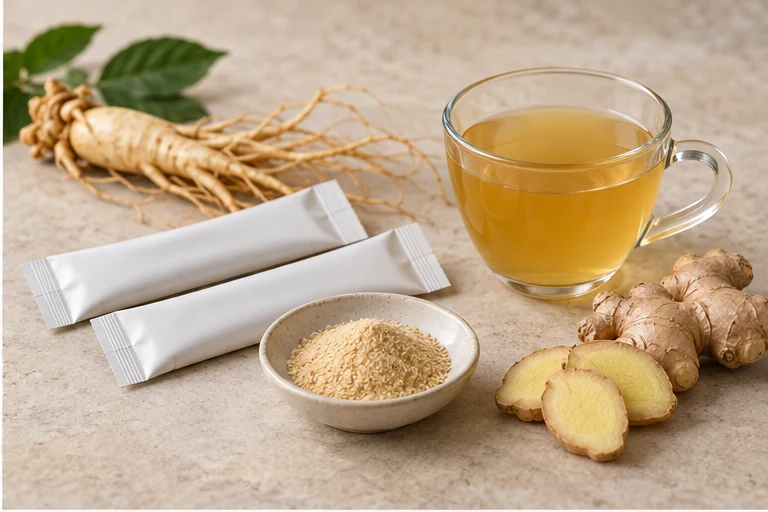
Select a dry ginseng extract with declared carrier content. Use ginger flavour as a sensory companion, a permitted sweetener to balance the cup, and an appropriate soluble carrier to support handling and dispersion. Ginger is a flavour choice here, not a demonstrated synergistic health treatment.
Sieve the dry components under a controlled moisture environment. Premix low-inclusion components into part of the carrier, blend with the ginseng extract and remaining carrier, and check blend uniformity before filling moisture-protective sachets. If direct blending gives poor dispersion, compare an agglomerated trial; do not assume a change in particle size leaves analytical recovery unchanged.
Test reconstitution in both the intended hot-water preparation and a colder misuse condition, noting floating powder, lumps, sediment and taste. Track caking, moisture gain, fill consistency and marker recovery through storage. Set the ginseng serving through safety and regulatory review rather than copying the trial’s extract mass.[19]
Single-botanical ginseng capsule
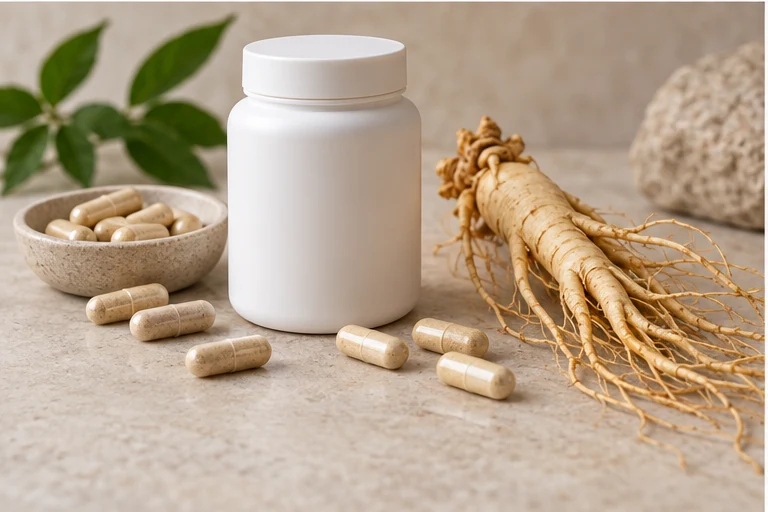
Use a defined dry ginseng extract as the botanical component. Select a compatible capsule shell, a filler only as needed for the target fill, and a permitted flow aid only if the blend requires it. A single-botanical format keeps attribution and identity testing simpler than adding an unsupported multi-herb health story.
Check extract particle size, moisture and bulk handling before blending. Premix any low-level excipient, blend with the extract, add any flow aid at the qualified stage, then encapsulate. Sample the blend and filled units for uniformity; package only after the agreed release checks. These operations require a qualified manufacturing process, not an assumed universal mixing time.
Evaluate shell–fill moisture compatibility, flow, fill variation, disintegration and marker recovery with the proposed pack. Set component and finished-product specifications for the actual supplement jurisdiction. Trial doses in the fatigue paper concern its own extract, not this capsule concept.[12][19]
Processing and equipment
Fix white/red/black root identity before extraction. A beverage brief needs flavour and heat/acid profile retention; a converted-ginsenoside target needs controlled conversion and precursor/product accounting, not merely longer evaporation.[3] [15]
For a root-based ingredient, the development route is authentication and cleaning, followed by the selected drying or steaming history, milling where needed, and sieving. A dryer, steamer, mill and sieve serve different stages; record the history rather than calling all resulting powders extract. The distinction between white and red ginseng begins before extraction.[11][14]
For a soluble extract, use an extraction vessel suited to the chosen solvent, a solid–liquid separation step, and concentration before the selected drying or liquid-finishing operation. These are process-design choices, not a validated equipment train. The fatigue trial used an ethanol extract that was concentrated and freeze-dried; a spray-dried commercial powder with added carrier is not automatically its equivalent.[19]
Acidity and heat belong in the same process review. A laboratory study found that organic acids influenced conversion of major to minor ginsenosides during high-temperature treatment. Its 130°C experiments do not predict retention in an ordinary bottled drink, but they justify measuring the ginsenoside profile after the actual acid addition and thermal cycle.[21]
The black-ginseng patent below combines steaming, coating, further treatment, extraction, enzymes and yeast fermentation. It is one disclosed route, not a definition of all black ginseng and not a recommendation to add each operation to an existing factory. Fermentation and enzyme steps require their own endpoint, hygiene and composition controls.[2]
Quality and safety
Ask for botanical identity and plant part, processing history, extraction solvent, extract ratio with its definition, carrier identity and amount, moisture basis and the analytical method. Include a chromatographic fingerprint and named ginsenosides suitable for that material rather than comparing differently defined totals. EMA’s preparation-specific descriptions show why the solvent and assay definition matter.[11]
Set contamination limits and test methods for the actual market and supply chain. For US dietary supplements, component, in-process and finished-product specifications must support identity, purity, strength, composition and contamination control. For heavily heat-processed material, include a review of process contaminants rather than checking only a desirable ginsenoside.[12][13]
Use the finished product as the stability test article. For a drink, follow sediment, colour, flavour, microbial quality and the chosen marker profile through the proposed storage conditions. For powder and capsules, add moisture uptake, caking or flow, package protection and delivery consistency to the trial plan. These are proposed development checks; no shelf life has been established for the concepts here.
EMA does not recommend the monograph preparations for people under 18, or during pregnancy or breastfeeding, because adequate data are lacking. It reports gastrointestinal complaints, hypersensitivity reactions and insomnia, with frequencies unknown.[11]
The monograph records no reported interactions; this is not a guarantee that every combination with medicines is safe. Someone taking medicines should have the actual product and medication list reviewed by a clinician or pharmacist. EMA advises consultation when symptoms persist longer than two weeks during medicinal use, and when they worsen.[11]
Keep fatigue treatment, immune-disease prevention, cancer treatment and guaranteed performance claims out of these product plans. The trial described above is narrow and mixed, and the manufacturing patents do not establish clinical efficacy. Verify ingredient permission, product category and claim wording separately in each sales market.[19][1][2]
Buy this ingredient: specifications, COA, certification documents & pricing →
Practical questions
Is red or black ginseng always better? No universal comparison follows from processing colour. Steaming changes composition, while the black-ginseng process research evaluates desirable constituents and benzopyrene together. Choose a specified material for the intended product instead of ranking it by colour.[13][14]
Does a higher extract ratio mean a stronger product? The ratio alone does not describe solvent selectivity, carrier content or the final ginsenoside profile. Compare the full specification. EMA lists different solvents and ratios for distinct preparations rather than giving a single conversion for all ginseng products.[11]
Can a patent recipe be used as proof or copied directly? A patent describes an invention and its claims, not a regulatory approval or a clinical validation. The two families below address different problems: bitterness in a finished food and production of a processed ginseng ingredient. A jurisdiction-specific claim and legal-status review is still needed before commercial use.[1][2]
Research cases
An institutional abstract of black-ginseng optimization describes changes in acidic polysaccharides, polyphenols, Rg3 and benzopyrene with repeated heating and drying, and includes benzopyrene in its response-surface optimization.[14] The available record was an institutional abstract without verified original loading or equipment scale; its reported optimum temperature/time is therefore not presented as a reproducible operating condition here. The defensible research lesson is multi-objective optimization: increasing a selected ginsenoside does not ensure every quality dimension improves. Evaluate thermal-process contaminants according to the actual process risk instead of inferring safety from colour or cycle count.
A valuable new programme could use one P. ginseng root batch to prepare a low-thermal-exposure reference, a controlled-steaming sample and an isolated ginsenoside-rich fraction. Measure initial acidity, moisture and malonyl/neutral profiles, then compare products under heating. This tests the paper's matrix-acid mechanism without letting origin, age and part obscure it.[3] R&D should repeat representative batches; engineering should capture actual product temperature and residence; QA should use one consistent assay; procurement should incorporate stability and acceptance rate, not select only the best experimental batch.
Failure diagnosis should follow reaction paths. Rb1 rising and then falling during steaming calls for checking malonyl-precursor release followed by deglycosylation before declaring loss of control. Different Rg3 results at the same nominal time/temperature call for root-size, moisture, acidity, loading and core-history comparison. Declining beverage peaks after heating call for examining Rg3/Rk1/Rg5 and sediment recovery together to distinguish conversion, precipitation and inadequate analytical extraction. Correct colour with the wrong profile calls for separating non-saponin browning from the target reaction rather than continuing to darken the material.[3][15]
A useful final research dossier therefore connects seven records: root identity, steam–dry history, selected ginsenoside profile, acidity/organic acids, extraction-stream balance, concentration/drying changes and finished-matrix stability. R&D learns why the process works; engineering gains an endpoint; procurement gains comparable materials; QA gains a deviation trail; and the brand gains authentic process knowledge without exaggerated clinical claims.
Relevant patents
US9011940B2
Granted US patent (B2). Original applicant/assignee: Amorepacific Corporation. Priority / filing / publication: 2011-05-31 / 2012-05-31 / 2015-04-21.[1]
Granted claim 1 concerns adding a composition consisting essentially of indigestible maltodextrin and citrus extract to a bitter food containing a specified ginseng extract. Both components matter: the abstract’s emphasis on maltodextrin alone is not the complete granted claim. Dependent claims narrow concentrate solids and component characteristics. The primary cover confirms the assignee, priority, PCT filing and grant publication dates.[1][10][1]
Relevant to the citrus-drink masking screen, not proof that any citrus-flavoured ginseng beverage works. The family includes WO2012165876 and US20140093590A1; these are not additional independent inventions. The cited filing date is the PCT filing, while US national-stage information appears separately on the cover.[1][10][1]
WO2012074159A1
PCT application publication (A1). Original applicant/assignee: AN, Jun Min (안준민). Priority / filing / publication: 2010-12-03 / 2010-12-13 / 2012-06-07.[2]
Published claim 1 combines first steaming, application of an edible coating, second steaming with ultraviolet treatment, hot-water extraction, alpha-amylase and cellulase treatment, and Saccharomyces cerevisiae fermentation. The translated claims name dependent coating options. This is a combined processing claim, not simply repeated steaming.[2]
Relevant to selecting a processed ingredient and documenting its history, rather than a finished-drink mixing recipe. The primary publication cover identifies applicant/inventor AN, Jun Min, resolving the aggregator’s generic “Individual” entry. Its Korean priority application 10-2010-0122763 is distinct from the bitterness family’s 10-2011-0052009. The Korean publication and translated web text should be reviewed together before interpreting scope.[2]
References
- US9011940B2 - Bitter-taste inhibitor and ginseng composition comprising same · 2026-09-11
- WO2012074159A1 - Black ginseng production method · 2026-09-11
- Final European Union Herbal Monograph Panax Ginseng Camey Radix Revision 1 En · 2026-09-11
- 21 CFR 111.70 -- What specifications must you establish? · 2026-09-11
- Optimization of the manufacturing process for black ginseng · 2026-09-11
- Phytochemistry of Red Ginseng, a Steam-Processed Panax ginseng · 2026-09-11
- Ginseng fatigue randomized trial · 2026-09-11
- Ginseng organic acids and heat · 2026-09-11
- Patent 2 primary publication PDF; cover visually verified · 2026-09-11
- US9011940B2 primary granted patent PDF · 2026-09-11
Material and processing background sources
- Influence of organic acids and heat treatment on ginsenoside conversion - PMC · 2026-09-09
- European Union herbal monograph on Panax ginseng C.A.Mey., radix · 2026-09-09
- 21 CFR 111.70 -- What specifications must you establish? · 2026-09-09
- Optimization of the manufacturing process for black ginseng - Kyung Hee University · 2026-09-09
- Phytochemistry of Red Ginseng, a Steam-Processed Panax ginseng. · 2026-09-09