A powder sold for dietary fibre can also be sold for cooking—and even for watercolour binding. In a September 22, 2026 Amazon.com sample, XPRS Nutra’s 4-ounce gum arabic listing put “Food Grade” and “Watercolor Paint” in the same title, then described food emulsification and dietary fibre in its bullets.[3] That overlap is the starting point for understanding acacia gum, not evidence of an inconsistent material identity.
The useful distinction is not “fibre-grade versus art-grade.” It is between the amount of fibre a formulation delivers and the behaviour of an oil–water interface. Commercial acacia products offer evidence for both, but the evidence is different: a dry-basis fibre specification does not establish emulsion performance, and a successful emulsifier trial does not provide an as-supplied fibre assay.[5][10]
Three retail listings show why the names cannot do the selection
Our original sample comprised eight search results for “acacia gum arabic powder” on Amazon.com, followed by three purposively selected product-detail records. The first three results were XPRS size variants, not three independent suppliers. This is a small positioning snapshot, not a sales or market-share survey.[1]
| Retrieved listing | What the seller foregrounded | What the text actually establishes |
|---|---|---|
| MB Herbals, B09652SR24, 8 oz / 227 g | What the seller foregroundedAcacia senegal, West African resin, soluble dietary fibre; also drinks, baking and stabilization | What the text actually establishesA stated botanical source and overlapping nutrition/culinary uses, not a measured fibre percentage.[2] |
| XPRS Nutra, B0C15GLWM1, 4 oz | What the seller foregroundedWatercolour binder, food thickener, stabilizer, emulsifier and dietary fibre | What the text actually establishesMultiple uses within one listing; the watercolour claim does not cancel the advertised food uses.[3] |
| Modernist Pantry, B07XYGM2JT, title 50 g / 2 oz | What the seller foregroundedHard and soft candies, icings, fillings, chewing gum and modernist cooking | What the text actually establishesA culinary emphasis, not proof of superior emulsification or purity.[4] |
MB Herbals is especially useful because its fibre language sits beside thickening and stabilization claims. XPRS makes the overlap explicit. Modernist Pantry approaches the same name through food preparation rather than nutrition. None of the three original detail-text records provides a controlled emulsion comparison or a comparable fibre assay.[2][3][4] The subsequently inspected package images add ingredient and nutrition declarations, but still do not establish a performance ranking.
The records also contain attributes that should not be promoted into composition evidence: MB’s “Region of Origin: Asia” alongside a West African sourcing statement, and Modernist Pantry’s “Flavor: Chocolate” alongside a pure gum arabic title.[2][4] We inspected seller-hosted package photographs, not purchased packs; the images do not resolve every listing attribute. They do not demonstrate cocoa addition, adulteration or false origin. Nor does Modernist Pantry’s warning about industrial material establish that either other sampled product is industrial grade.[4]
What the package images add
We reviewed the initial image galleries associated with these same three ASINs, archived late on September 22, 2026 UTC. These are seller-hosted images, not current-batch assays. The XPRS collage includes a readable B0C15GLWM1 sticker and a 4 oz (113 g) front label; its flat label artwork is recorded separately rather than treated as an identical version.[16][19]
| Product | Visible ingredient declaration | Fibre declaration and usable scope |
|---|---|---|
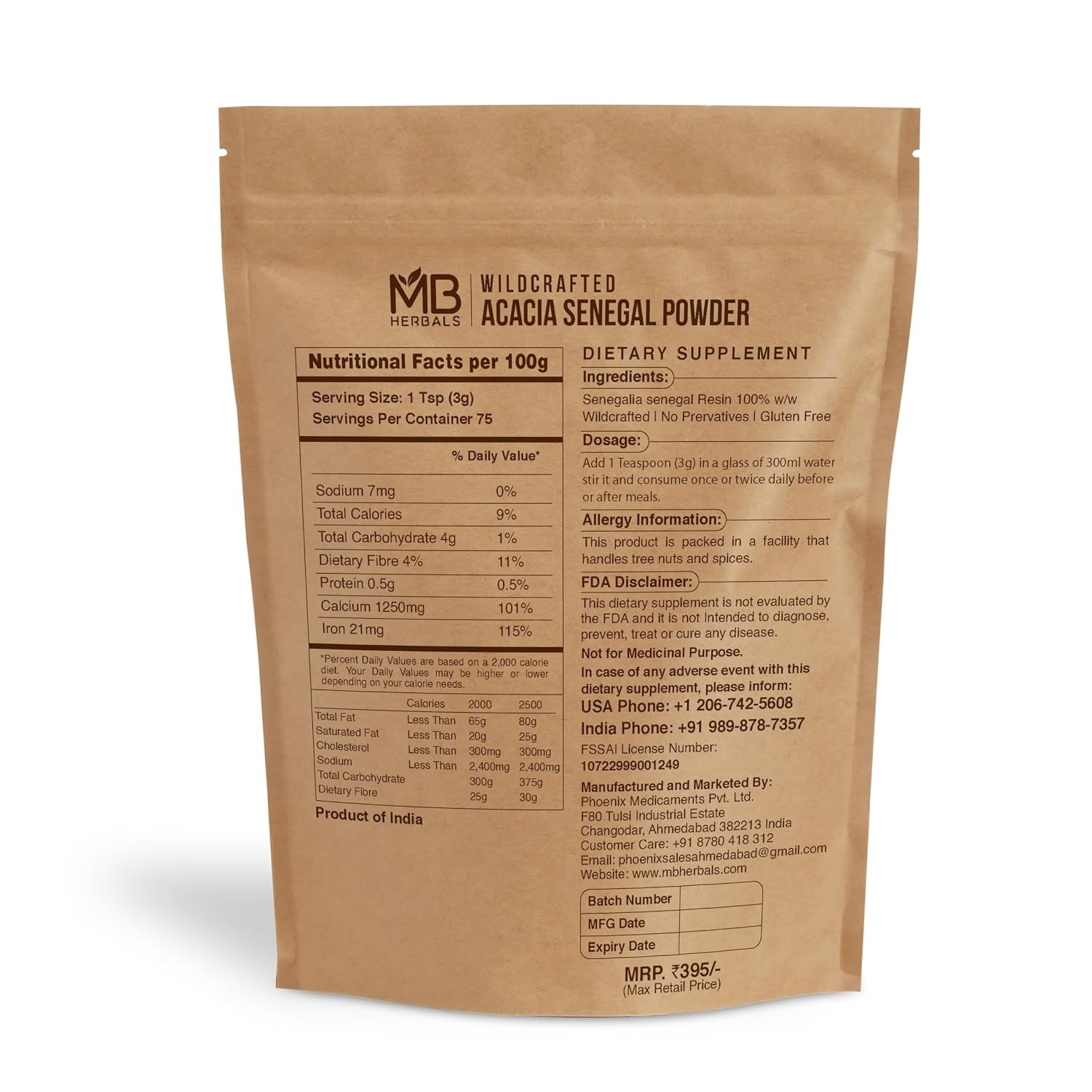
| MB Herbals | Visible ingredient declaration“Senegalia senegal Resin 100% w/w” | Fibre declaration and usable scopeThe heading says “Nutritional Facts per 100g,” alongside a 3 g serving and 75 servings. The fibre row reads “Dietary Fibre 4%,” with 11% in the daily-value column—not 4 g. This cannot supply a dependable grams-of-fibre-per-serving value.[15] |
| XPRS Nutra | Visible ingredient declarationArtwork: “Gum Arabic (Acacia Senegal L. Willdenow):”; the photograph's smallest trailing ingredient text is not fully legible | Fibre declaration and usable scopeThe photographed Supplement Facts lists 2 g fibre per 2.5 g serving and 45 servings, but also 0 g total carbohydrates. Preserve both entries; do not turn their unresolved inconsistency into a verified fibre assay.[16][19] |
| Modernist Pantry | Visible ingredient declaration“senegal gum acacia” | Fibre declaration and usable scopeNutrition Facts states 85 g dietary fibre per 100 g, not per serving. No serving size or serving count is visible. This is a package declaration, not a soluble-fibre dry-basis specification.[17] |
This changes the reading of the sample: the culinary-positioned Modernist product also carries a numerical fibre declaration, while the fibre-positioned MB image does not yield a reliable per-serving value. Marketing emphasis alone therefore cannot identify the most suitable fibre ingredient.[15][17] Nor can the Modernist declaration be ranked against Fibregum’s 90% soluble-fibre dry-basis minimum: the fibre definition and reporting basis differ.[5][17]
The Modernist front actually prints “50g/2 OZ”; those quantities are not equivalent, and the image does not establish the filled weight.[18] Its back lists only senegal gum acacia, not chocolate.[17] MB’s back says “Product of India,” which does not itself identify or disprove the resin’s claimed West African harvesting origin.[2][15] These are documentation issues, not evidence of adulteration or fraud.
The industrial question therefore remains open after reading the titles and labels: which gum meets the intended fibre target, and which can stabilize the intended oil load under the available process?
Commercial products put numbers behind two different objectives
Nexira’s Fibregum product page guarantees a minimum of 90% soluble fibre on a dry-weight basis. It also describes low viscosity and an odourless, colourless, tasteless solution, but the public page does not pair those sensory and viscosity descriptions with a concentration, temperature or measured viscosity value.[5]
For a fibre-enriched drink, the quantitative specification is the useful starting point. It is not equivalent to 90% fibre in every delivered bag. If the fibre fraction on dry matter is f and the delivered moisture fraction is m, the corresponding as-supplied fraction is f × (1 − m). For illustration—not a Fibregum batch result—a material with 90% dry-basis fibre and 10% moisture would contain 81% fibre by delivered mass. A hypothetical 5 g fibre target would then require about 6.17 g of powder rather than 5.56 g. This is mass-balance arithmetic, not a recommended dose or a nutrition-label calculation.
Nexira’s Eficacia Advanced addresses a different constraint. The manufacturer identifies it as a highly granulated “100% natural acacia gum emulsifier” and describes selected Acacia senegal gum processed using proprietary technology.[10][11] Its application report compares it with an identifiable conventional product, Instantgum AA, rather than merely calling it “premium.”[10]
| Commercial reference | Publicly disclosed basis | What it helps decide |
|---|---|---|
| Fibregum | Publicly disclosed basisMinimum 90% soluble fibre, dry basis | What it helps decideFibre mass balance, once moisture and the applicable analytical/label basis are confirmed.[5] |
| Eficacia Advanced | Publicly disclosed basisSelected A. senegal; proprietary processing; highly granulated form | What it helps decideA named candidate for emulsion development, with a published manufacturer formulation comparison.[10][11] |
| Instantgum AA | Publicly disclosed basisNamed comparator in that formulation report | What it helps decideA concrete conventional-gum baseline, not a stand-in for every gum arabic powder.[10] |
These are not mutually exclusive material categories. They are documented commercial references with different performance commitments. There is no basis here for declaring Fibregum incapable of emulsification or Eficacia Advanced devoid of dietary fibre.
A real manufacturer comparison—and the limits of its numbers
Nexira reports full stability with 5% Eficacia Advanced versus 18% Instantgum AA in a flavour-emulsion formulation containing 8% D-limonene and 7% glycerol ester of wood rosin. Its displayed Advanced recipe additionally contains 0.20% potassium sorbate, 0.10% citric acid and 79.70% water.[10]
This is a specific manufacturer-reported comparison, not an independently verified equivalence trial. It is not evidence that the three retail powders need 18%, nor that every beverage can use 5%. The public report does not disclose the measured pH, homogenization pressure and passes, or storage temperature and duration. Its droplet-distribution figure supplies neither a time series nor those missing process conditions. The page gives only the Advanced recipe in full; the percentages are not explicitly identified as w/w or w/v.[10]
There is also a numerical reason not to repeat the sales headline uncritically. Moving from 18 to 5 is a calculated reduction of about 72%, whereas the accompanying text says “up to 65%.”[10] Keep the stated test additions separate from that headline. Neither percentage establishes cost savings without comparable ingredient prices and processing costs.
The comparison justifies investigating a lower-dose emulsification route. A separate controlled research example is needed to explain why gum identity, concentration and processing must still be considered together.
Under controlled conditions, concentration changes the comparison
In the publicly available 2019 pre-proof, Han and colleagues compared standard gum arabic (STD) with matured commercial gums EM2 and EM10 and with experimentally fractionated materials. The matured gums came from San Ei Gen FFI; these are not the Nexira products or the retail samples above.[14]
Their model emulsions used MCT oil, 0.12% w/v citric acid to reach approximately pH 4, and 0.13% w/v benzoic acid. Preparation comprised high-shear mixing at a reported 26,000 rpm for three minutes, followed by three high-pressure homogenizer passes at 75 MPa. Initial droplet measurement followed one hour at 20 ± 2°C; the study also examined accelerated storage at 60°C. The methods describe three consecutive instrument measurements per run, not three independently manufactured batches.[14]
Table 1 keeps MCT at a listed 10% while changing gum from 10% to 5%. At the 1:1 gum/oil ratio, the reported volume-weighted mean diameter D[4,3] was 0.67 for STD, 0.60 for EM2 and 0.47 for EM10. At 1:2, the respective values were 1.10, 1.01 and 0.82. The table prints these diameter values without an explicit unit in the column heading; the surrounding droplet plots use micrometres. It also labels gum and MCT concentrations only as %, so those entries should not be silently relabelled w/w or w/v.[14]
The larger-droplet fraction makes the formulation penalty particularly clear. The reported fraction above 1 µm in the volume-based droplet-size distribution rose from 1.96% to 29.85% for STD and from 1.60% to 24.28% for EM10 when gum was halved at the same listed oil concentration.[14] Even EM10 did not make dosage irrelevant.
The ranking also depends on the metric. At 1:2, EM10 had a smaller D[4,3] than STD, but a larger Sauter mean D[3,2]—0.72 versus 0.46.[14] Calling one sample simply “smaller-droplet” would erase that distinction. Figure 2a–b follows STD and matured gums at baseline, day 3 and day 7 at 60°C; the longer 21-day series concerns the HA-fractionated materials, not all samples.[14] The pre-proof also has a visible mismatch between the initial STD 1:1 D[3,2] in Table 1 and Figure 2a; the numerical comparisons here follow Table 1, not digitized curves. These accelerated data are not a finished-beverage shelf-life guarantee.
The study links functional differences to the arabinogalactan–protein complex, or AGP. Table 1 reports GPC-MALLS-derived AGP contents of 11%, 17.9% and 28% for STD, EM2 and EM10. Increasing AGP further by fractionation did not simply keep reducing droplet size: larger droplets could also be relatively stable.[14] AGP content here is the proportion assigned to the protein-containing complex, not total protein percentage. Fractionation also changes the material, so these results do not isolate AGP percentage as the sole cause. A total fibre percentage, botanical name or single initial size value cannot serve as an emulsification score.
Choose the performance target without inventing separate substances
For a fibre beverage without a substantial dispersed oil phase, start with the fibre delivered per serving and then evaluate dissolution, taste and viscosity at that actual addition. Fibregum supplies a dry-basis numerical starting point; the retail label values above do not supply an equivalent soluble-fibre dry-basis assay.[5][15][17]
For an oil-containing flavour concentrate, fix oil identity and loading before comparing gums. The Nexira example reports different tested additions for two named products; the MCT study shows that halving gum can increase the large-droplet fraction even with a matured gum.[10][14] A fair trial should therefore compare the required dose to reach the same defined physical endpoint, not only equal grams of powder.
Do not confuse quicker wetting with a different dissolved emulsifier. Alland & Robert explicitly says its high-density Beyond Acacia granules improve wettability while preserving the functional properties of the corresponding regular and instant qualities once dissolved.[8] Powder handling and interfacial performance are separate questions.
That brings the retail sample back into focus. XPRS’s simultaneous fibre, food and watercolour language is not the problem to solve. The practical issue is that a shared name and multiple advertised uses do not reveal the fibre delivered or the dose needed to stabilize a particular emulsion. Commercial specifications and condition-matched tests can answer those two questions without inventing a false division between “nutrition gum” and “art gum.”
Sources
[1] Amazon.com : acacia gum arabic powder
[4] Pure Gum Arabic Powder [Acacia Gum] ⊘ Non-GMO Gluten-Free Vegan OU Kosher Certified - 50g/2oz
[8] BEYOND ACACIA® - Alland & Robert
[10] Eficacia Advanced manufacturer formulation comparison — Nexira
[11] Eficacia Advanced product identity — Nexira
[14] Han et al. 2019 pre-proof full text
[15] Package image B09652SR24 B09652SR24-gallery-02.jpg
[16] Package image B0C15GLWM1 B0C15GLWM1-gallery-07.jpg

[17] Package image B07XYGM2JT B07XYGM2JT-gallery-03.jpg


